
Quick Answer:
The choice between injectable and oral GLP-1 medications comes down to your lifestyle, needle comfort, weight loss goals, and how your body responds to each option.
- Injectable GLP-1s like Ozempic and Wegovy typically deliver 15 to 22 percent body weight loss but require weekly injections.
- Oral options like Rybelsus offer convenience with no needles, though they have historically shown 8 to 12 percent weight loss.
- New 2026 oral formulations are showing promising improvements that narrow the gap.
- If you want maximum results and can handle needles, start with injectables. If needle anxiety is real for you, oral formats still deliver meaningful weight loss with much better adherence.
Medvi offers both compounded and name brand injectable and tablet GLP-1 options that provides flexibility for your weight loss journey!
The GLP-1 medication landscape has exploded with options in the last 18 months. If you’re standing in a doctor’s office or browsing online evaluations trying to figure out whether to go with a needle or a pill, you’re not alone. It’s honestly a more nuanced decision than most people realize, and marketing hasn’t helped both formats have strong communities of advocates online, each convinced their choice is superior.
This guide cuts through the noise. We’ll break down the real differences in effectiveness, convenience, side effects, cost, and the lifestyle factors that matter most. By the end, you’ll know exactly which format aligns with your needs, values, and health goals.
In This Guide
- Weight Loss Results: What You Can Actually Expect With GLP-1 Medication
- The Convenience Factor: What Weekly Injections vs Daily Pills Look Like in Real Life
- Side Effects Showdown: Which GLP-1 Format Is Easier To Live With Day-to-Day?
- Cost Comparison: What You’ll Likely Pay With Insurance, Cash, and Hidden GLP-1 Expenses
- Absorption and Timing: How Your Body Handles Injectable vs Oral GLP-1 (and Why It Matters)
- Special Situations: When Other Medications or Health Conditions Change Your Best GLP-1 Option
- The Psychology of Medication: How Needles, Pills, and Habits Impact Your Long-Term Success
- Combined Therapy: When Using Injectable and Oral GLP-1 Together Might Make Sense (and When It Doesn’t)
- What the Newest Research Says in 2026: Big Updates for Injectable and Oral GLP-1s
- Making Your Final Decision: A Simple Step-by-Step Framework To Choose Your Best Format
- Key Takeaways: The Most Important Points To Remember Before You Decide
- Your Next Steps: Exactly What To Do Before You Start a GLP-1 (or Switch Formats)
- Final Thoughts: How To Think About GLP-1s As a Long-Term Tool, Not a Magic Fix
Let’s start with the metric that matters most to most people: how much weight will you actually lose?
Injectable GLP-1s (Ozempic, Wegovy, Mounjaro, Zepbound, Saxenda, Compounded):
In clinical trials, injectable medications consistently showed the strongest results:
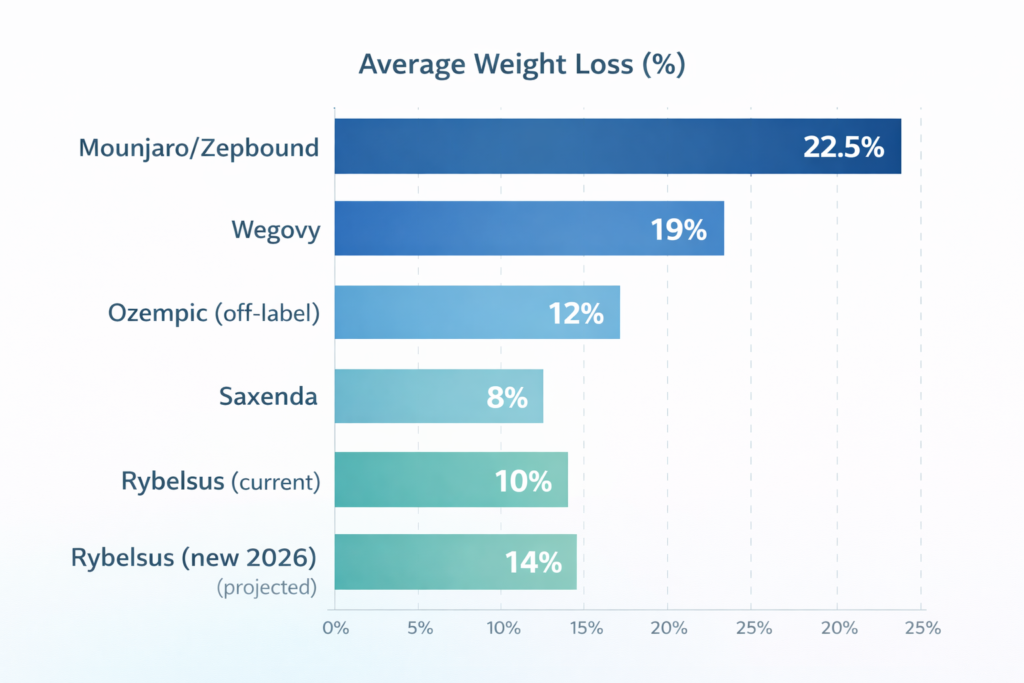
- Wegovy (semaglutide): 15-22% body weight loss over 68 weeks
- Mounjaro (tirzepatide): Up to 22.5% body weight loss over 72 weeks
- Zepbound (tirzepatide – OTC version): Similar 22%+ results
- Saxenda (liraglutide): 5-10% body weight loss
- Ozempic (semaglutide for diabetes): 10-15% weight loss (off-label for weight)
- Compounded (non-name brand versions): Offer the same or similar results as the name brand options at a fraction of the price
Real-world example: Sarah, 45, lost 65 pounds over 18 months on Wegovy. She describes it as “the medication did the heavy lifting, but I still had to show up with discipline around food.”
Oral GLP-1s (Rybelsus, Compounded):
Historically modest, but evolving:
- Rybelsus (oral semaglutide): 8-12% body weight loss in trials
- Compounded (non-name brand versions): Offer the same or similar results as the name brand options at a fraction of the price
- New 2026 formulations: Reports of 12-16% loss emerging from beta programs
Real-world example: Marcus, 52, started Rybelsus and lost 28 pounds over 12 months. He says: “I’ve heard bigger numbers from injection users, but consistency was easier for me because I hate needles.”
Why the difference in injectable vs oral?
Absorption matters. Injectable medications bypass your digestive system entirely, so you get full bioavailability. Oral medications have to survive stomach acid and intestinal processing, meaning your body absorbs a lower percentage of the active drug. New formulations with permeation enhancers are narrowing this gap in 2026.
Where Compounded GLP-1s Fit In
Many people are now accessing GLP-1 medications through online telehealth programs that offer compounded semaglutide and tirzepatide instead of only brand-name options.
Compounded medications use the same active ingredients as Wegovy, Ozempic, Mounjaro, and Zepbound, but are prepared by licensed U.S. compounding pharmacies for individual patients at much lower monthly costs, typically ranging from about $199 to $499 per month.
Programs like Skinny Rx, Medvi, Eden, and Elevate focus on these compounded options, combining medication access with telehealth physician oversight, follow-up support, and shipping, which makes them a realistic path for people without strong insurance coverage.
Compounded GLP-1s are not individually FDA-approved finished products, so quality and safety depend heavily on choosing reputable programs that work with properly licensed pharmacies and provide real medical supervision.
This isn’t just a clinical question it’s a lifestyle one. And honestly, this section might matter more than the weight loss numbers for some people.
Injectable GLP-1s:
The commitment: Weekly injections (for most formulations). You can do it yourself at home, or many people use medical spas and telemedicine clinics that handle injections.
Pros:
- Fire-and-forget: One injection per week means seven days between doses
- No daily habit: If you’re the type who forgets daily meds, this might be your answer
- Consistency: It’s harder to “skip” a week than to skip daily pills
- Travel-friendly: One pen per week fits easily in a purse or luggage
- Results: Currently more effective than taking the medication orally
Cons:
- Needle anxiety: 20-30% of people have clinically significant needle phobia
- Scheduling: If you’re traveling every weekend, timing your injection matters
- No discretion: You need privacy to inject; can’t do it on a crowded bus
- Learning curve: First self-injection requires instruction (though videos help)
Oral GLP-1s (Rybelsus):
The commitment: Daily medication, taken on an empty stomach with specific timing.
Pros:
- Familiar format: If you’re already taking daily medications, this fits your routine
- No injection anxiety: For needle-phobic people, this is literally life-changing
- Maximum discretion: You can take it anywhere
- Flexible timing: Within guidelines, you have options
Cons:
- Daily discipline: You must take it every single day, empty stomach, 30 minutes before food
- Absorption inconsistency: Coffee, juice, food timing, acid reflux medications all affect absorption
- More complex: Three daily tablets (current Rybelsus protocol) vs. one weekly injection
- Easy to forget: Miss one day? You’ve interrupted your consistency
- Results: Typically less effective than injectable forms
Real-world example: Patricia, 61, takes Rybelsus. She explains: “I’ve been taking blood pressure medication every morning for 15 years. Adding Rybelsus felt natural. The hard part is remembering not to eat anything for 30 minutes afterward. I’ve messed that up plenty of times.”
Side Effects Showdown: Which Format Is Easier to Handle?
Here’s what nobody wants to talk about at dinner parties: GLP-1 medications can cause some pretty uncomfortable side effects, especially in the first 4-8 weeks. But the format matters for how you experience them.
Common Side Effects (Both Formats):
- Nausea (most common, 30-40% of users)
- Vomiting
- Constipation (seriously, this is a big one)
- Diarrhea (sometimes alternating with constipation)
- Stomach pain
- Headaches
- Fatigue
- Loss of appetite (intentional, but sometimes too aggressive)
From what I have seen, nausea is the deal-breaker for about 15 percent of people who try GLP-1s, which is why understanding how each format handles side effects matters so much.
Injectable Format:
With injectable GLP-1s, side effects typically spike in the first 2-3 days after injection, then gradually subside. This is somewhat predictable.
Advantage: You know when it’s coming. Monday nausea? Plan for Tuesday recovery. Many users describe it as manageable because they can anticipate it.
Disadvantage: Intensity can be severe for some people. One injection delivers a full week’s dose, so there’s no “stopping” mid-dose if you’re having a rough reaction. You’re committed to riding it out.
Oral Format:
With daily pills, side effects can be more variable and unpredictable. Some days feel fine; others don’t.
Advantage: You can dose-adjust relatively easily. If you’re struggling, you might skip a day or take a lower dose tablet to see if symptoms improve.
Disadvantage: The unpredictability can be frustrating. You never know if today will be a good or bad day. And absorption issues mean you might have inconsistent side effect patterns.
The GI Tract Reality:
Both formats primarily affect your digestive system. But here’s a nuance: injectable users report that high-dose nausea (during the first month) is more intense but then improves significantly. Oral users report more persistent but lower-level GI complaints over time.
Real-world perspective: “I threw up twice on my first Wegovy injection. It was awful. But by week 4, I was fine. The nausea just… stopped,” versus “I’ve been on Rybelsus for 6 months and I still get a queasy feeling about an hour after taking it most days.”
If you are looking for more information on side effects, check out our detailed article on what to expect and how to combat them:
GLP-1 Side Effects: What’s Normal, What’s Manageable, and When to Worry [2026]
Cost Comparison: Insurance, Cash Pay, and Hidden Expenses
This might be the deciding factor for you. The financial reality is very different depending on your insurance status.
Brand-Name GLP-1 Costs
Hidden Costs to Factor In:
Injectables:
- Pharmacy consultation (if self-injecting): $0-100
- Medical spa/clinic injections: $50-200 per injection (yes, people do this!)
- Needles/sharps (if buying separately): $20-50/month
- Travel to provider appointments: Gas, parking, time off work
Orals:
- Empty stomach requires timing coordination: No direct cost, but lifestyle planning
- Potential drug interactions: If you need additional medications to manage side effects
- Absorption-friendly meals: Some people find they need specific meal timing/composition
Telehealth and Compounded GLP-1 Options:
For many people without strong insurance coverage, online GLP-1 programs using compounded medications have become the most realistic path to access. Programs like Medvi, Eden, Enhance.MD and DirectMeds offer compounded semaglutide and tirzepatide at monthly costs typically ranging from about $199 to $329, often including medical oversight, shipping, and follow-up support.
Compounded medications use the same active ingredients as brand-name drugs but are prepared by licensed pharmacies for individual patients. They are not individually FDA-approved products, so quality and safety depend heavily on choosing reputable programs and pharmacies.
Insurance Approval Patterns (2026):
Many major insurers now cover Wegovy for people who meet strict BMI and health criteria, but denial rates are still common.
Coverage for Mounjaro and Zepbound varies widely by plan and state, with approval often requiring documented diet and exercise failures.
Rybelsus coverage is less consistent than injectables, partly due to lower expected weight-loss outcomes in trials.
Ozempic coverage for weight loss (off-label use) is highly variable and frequently denied.
Saxenda coverage has declined as newer, more effective options have become available.
Compounded GLP-1 medications are typically not covered by insurance since they are prepared by compounding pharmacies rather than manufactured as FDA-approved finished products. Most people using compounded semaglutide or tirzepatide through telehealth programs like Skinny Rx, Medvi, Eden, and Elevate pay cash and should not expect insurance reimbursement.
Absorption and Timing: How Your Body Processes Each Option
This is where the science gets really interesting. The format you choose directly affects how your body absorbs and processes the medication.
Injectable Medications:
- Onset: 30 minutes to 2 hours
- Peak effect: 24-72 hours
- Duration: 7 days (most weekly formulations)
- Predictability: Highly predictable
- Affected by: Injection site, body temperature, hydration level (minimally)
Advantage: You don’t need to think about absorption. It’s consistent.
Oral Medications (Rybelsus):
- Onset: 30 minutes to 2 hours
- Peak effect: 1-3 hours
- Duration: 24 hours
- Predictability: Variable
- Affected by: Stomach contents, pH, food timing, digestive health, medications like metformin or proton pump inhibitors
Advantage: Daily dosing means if one dose isn’t absorbed well, the next day is a fresh start.
Disadvantage: You never know how much medication you actually absorbed.
The Empty Stomach Requirement:
Rybelsus must be taken on a completely empty stomach (30 minutes before food, 2 hours after). Here’s why: the medication molecule is too large to cross the intestinal barrier efficiently. It needs special absorption enhancers in the formulation, and food interferes with that process. This timing requirement affects real-world compliance dramatically.
Meal Timing Strategy for Oral Users:
6:00 AM – Take Rybelsus
6:35 AM – Can eat breakfast
Vs.
With injectables: Take Wegovy injection any time, eat normally immediately after
Special Situations: Medication Interactions and Contraindications
Not everyone can take every GLP-1 format. This matters.
Injectable-Specific Considerations:
- Thyroid cancer history: Contraindicated (both formats, actually, due to risk mechanism)
- Pancreatitis history: Usually cautioned against but not absolutely contraindicated
- Kidney disease: Monitoring needed, but not a complete block
- Severe gastroparesis: May worsen
Oral-Specific Considerations:
- Severe acid reflux (GERD): May be problematic due to pH sensitivity
- Gastroparesis: The empty stomach requirement could be challenging
- Medications that affect stomach pH: Including PPIs (proton pump inhibitors like omeprazole)
- Digestive disorders: IBS, Crohn’s disease may complicate absorption
Drug Interactions:
Injectables: Minimal interactions (bypasses digestive system, minimal hepatic metabolism)
- Generally compatible with most medications
- Possible interaction with other GLP-1 drugs
- Potential for increased hypoglycemia risk if combined with insulin
Orals: More potential for interactions
- Metformin: Can reduce Rybelsus absorption by 20-30%
- Proton pump inhibitors: Reduce absorption
- Diabetes medications: Increased hypoglycemia risk
- Digoxin and other cardiac medications: Monitor digoxin levels
The Bottom Line: If you have complex medical history, discuss format choice carefully with your prescribing provider. Neither is universally contraindicated, but your situation might favor one over the other.
The Psychology of Medication: Mental Barriers to Success
Here’s what won’t show up in clinical trials: the mental-emotional dimension of choosing your format.
Needle Anxiety and Phobia:
- 15-30% of the population has needle phobia
- Another 25-30% has significant needle anxiety (uncomfortable but manageable)
- For these populations, oral format can literally be life-changing
Real-world: “I wanted to try Wegovy so badly, but I had a panic attack during my first injection appointment. I switched to Rybelsus and it’s been game-changing.”
Drug Adherence Psychology:
- Daily medications: ~50-60% adherence long-term (one pill per day)
- Weekly injections: ~75-80% adherence long-term
- The weekly format creates a ritual that’s harder to skip
But there’s a flip side:
- Some people find the daily pill comforting (controlled, reversible)
- Some people find the weekly injection anxiety-inducing (can’t take it back)
Discretion and Social Factors:
- Injectables require privacy: You need to inject somewhere (bathroom at work?)
- Orals are invisible: No one needs to know
- Some people appreciate the “visible commitment” of injections
- Others find it a significant social burden
This isn’t trivial. If you’re someone who dreads a weekly injection ritual, you probably won’t stick with it 18+ months. And if you’re someone who forgets daily medications, the weekly injection is a better match for how your brain works.
Combination Therapy Studies:
Research is exploring whether combining low-dose injectables with daily pills could offer better results than either alone. This is still investigational but represents the frontier of treatment.
Muscle Loss Concerns:
Some 2025-2026 data suggests aggressive weight loss on GLP-1s can lead to lean muscle loss (10-20% of weight loss might be muscle). New guidance includes:
- Strength training recommendations
- Protein intake optimization (often 1.6-2.2g per kg body weight)
- This applies to both formats equally
What the Newest Research Says in 2026
The GLP-1 landscape is evolving rapidly. Here’s what’s changed or is emerging:
New Oral Formulations on the Horizon:
Several pharmaceutical companies are developing next-generation oral GLP-1s with improved bioavailability:
- New permeation enhancers: Promising 14-18% weight loss (vs. Rybelsus at 10-12%)
- Extended-release oral formulations: Potentially allowing dosing less frequently than daily
- Combination oral therapies: GLP-1 plus additional agents for potentially stronger effects
Timeline: 2-3 of these could hit FDA approval pathways by late 2026-early 2027.
Oncogenic Risk Reconsideration:
Recent longer-term safety data (beyond original trial windows) is suggesting the thyroid C-cell cancer risk might be lower in humans than originally feared. This doesn’t change current guidance, but ongoing surveillance is shifting.
Making Your Final Decision: A Simple Framework
Here’s a practical framework to help you decide:
Choose INJECTABLE if:
- You want the strongest possible weight loss results (15-22%)
- You have a good memory but struggle with daily routines
- You don’t have needle anxiety
- You’re willing to commit to a weekly ritual
- You want minimal variation in absorption
- Cost is not your primary factor (or insurance covers it well)
- You can handle temporary intense side effects upfront
- You’re traveling frequently and prefer a weekly commitment to daily discipline
Choose ORAL if:
- You have needle anxiety or phobia
- You’re already successful with daily medications
- You want the flexibility to adjust or skip doses if needed
- You prefer to keep medication use private/discreet
- You’re willing to accept potentially more modest results (8-14%)
- Medication interactions might be a concern for you
- You prefer lower-intensity, longer-term side effects over acute reactions
- You want a format you can theoretically stop immediately
Consider SWITCHING between formats if:
- You started injectable but cannot tolerate the injection anxiety
- You started oral but missed doses consistently
- You’re not seeing desired results after 3-4 months
- Side effects are unmanageable on your current format
Good news: Most providers will allow you to try one format and switch to the other if it’s not working for you. This isn’t a permanent decision.
Key Takeaways
- Injectable GLP-1s deliver 15-22% weight loss but require weekly injections and needle comfort
- Oral GLP-1s offer convenience and discretion with 8-14% weight loss and daily dosing requirements
- Injectables have more predictable absorption and fewer drug interactions
- Orals require empty-stomach timing and have more variable absorption
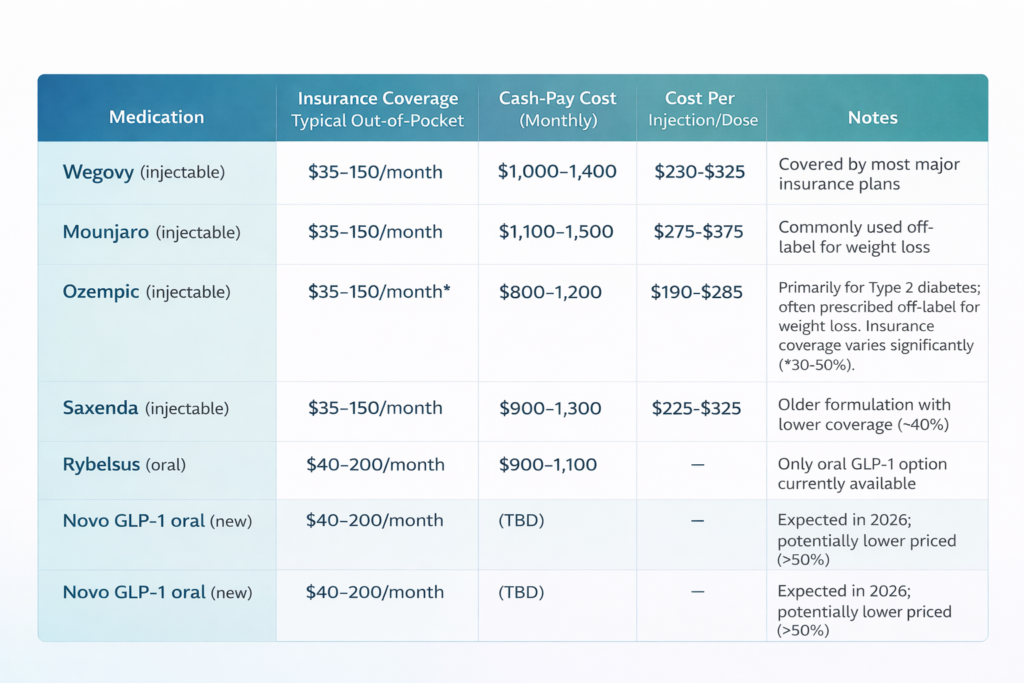
- Cost varies significantly: Injectable copays typically $35-150/month with insurance; orals $40-200/month
- Cash-pay prices range $800-1,500/month for either format without insurance for name brand and can be significantly cheaper if you choose a compounded option through a trusted telehealth provider.
- Injectable side effects are often more intense initially but improve; oral side effects tend to be more persistent
- Needle anxiety affects 15-30% of the population; for them, oral format can be transformative
- Weekly injections show better long-term adherence (75-80%) than daily pills (50-60%)
- This isn’t a permanent decision; format switching is common and acceptable
- New oral formulations emerging in 2026-2027 promise results closer to injectables
- Medication interactions matter more with oral GLP-1s than injectables
Your Next Steps
If you are still deciding between injectable and oral GLP-1 medications, here is where I would go next:
Review Do I Qualify for GLP-1 Weight Loss Medication? to confirm you meet the basic criteria before scheduling a consultation.
Read my Medvi GLP-1 Program Review, SkinnyRx Program Review, EnhanceMD Program Review and DirectMeds Program Review to see which telehealth option offers the format and support you need.
Open How GLP-1 Medications Work: Mechanisms, Timeline, and What to Expect to understand exactly what happens in your body when you start treatment.
Read GLP-1 Side Effects: What’s Normal, What’s Manageable, and When to Worry so you know what to expect in your first few weeks.
Look at What Should I Eat While Taking GLP-1 Medications? to set up your diet for success from day one.
Final Thoughts
Choosing between injectable and oral GLP-1 medications isn’t about finding the “objectively best” option. It’s about finding the best option for YOUR life, YOUR body, and YOUR goals. The injectable might deliver better weight loss numbers, but if you’re terrified of needles and will skip doses out of anxiety, those numbers don’t matter. Similarly, oral medications might feel convenient, but if you consistently forget daily doses, the injectables’ weekly format might be your ticket to success.
The good news is that we’re living in a moment where multiple effective options exist, and the landscape is only improving. New formulations emerging in 2026-2027 will likely narrow the gap between the two formats even further.
Remember: this choice doesn’t define the rest of your life. People switch formats. People start, pause, and restart. The goal is sustainable, consistent use of a medication that’s working for your body. Whether that’s a weekly injection, a daily pill, or something new coming down the pipeline. What matters is that you’re taking action toward your health.
The real work of weight loss and health improvement happens in the days between doses anyway: the food choices, the movement, the sleep, the stress management. The medication is powerful, but it’s a tool, not a magic solution. Use it wisely, monitor how you feel, and adjust as needed.
You’ve got this.
Medical Disclaimer
This article is for informational purposes only and should not be considered medical advice. GLP-1 medication eligibility, suitability, and appropriate formatting options vary significantly based on individual health status, medical history, current medications, and personal circumstances. The information presented represents general clinical patterns and publicly available research as of January 2026, but individual experiences and medical guidance may differ.
Only a licensed healthcare provider who has evaluated your complete medical history can determine whether you qualify for GLP-1 medications, which specific medication or format is appropriate for you, and how to safely monitor your treatment. This guide does not establish a doctor-patient relationship. Always consult with your prescribing physician before making any decisions about starting, changing, or stopping medications.
Sources
- Current FDA guidance on compounded GLP-1 medications and safety standards.
- FDA prescribing information and clinical trial data for semaglutide (Wegovy, Ozempic, Rybelsus) and tirzepatide (Mounjaro, Zepbound).
- Published research on GLP-1 receptor agonists, weight-loss outcomes, side effects, and real-world adherence patterns.
- Insurance coverage data and cash-pay pricing from major U.S. insurers and telehealth GLP-1 programs.
- Pharmacokinetic studies on injectable vs oral GLP-1 absorption and bioavailability.
Affiliate Disclosure
This website may contain affiliate links to telemedicine providers, pharmacy platforms, and other GLP-1-related services. When you click these links and complete a purchase or service enrollment, we may earn a commission at no additional cost to you. These affiliate relationships do not influence our editorial recommendations or medical guidance. We only promote services and products we believe genuinely serve our readers’ interests. Our commitment is to provide honest, unbiased information to help you make the best decision for your health and circumstances. For any questions about our affiliate relationships or our recommendation process, please contact us directly.
Last updated: June 2026