

Quick Answer:
Retatrutide, sometimes called “GLP-3”, is actually a triple hormone agonist targeting GLP-1, GIP, and glucagon receptors. Here’s what matters:
- Weight loss results: 28.7% at 68 weeks in Phase III trials (about 72 pounds for a 250-pound person)
- Availability: Still in clinical trials, FDA approval expected late 2027
- Side effects: Similar GI issues to Ozempic and Zepbound, plus a new concern about abnormal skin sensations
- Cost: Unknown until launch, but likely $1,200-1,500/month
- Who it’s for: People seeking maximum weight loss who haven’t hit their goals with current GLP-1s
Until Retatrutide is FDA approved, semaglutide and tirzepatide are excellent alternatives. Enhance.MD offers both options starting as low as $49!
If you’ve been following weight loss medication news, you’ve probably heard whispers about “GLP-3s” being the next big thing after Semaglutide (Ozempic) and Tirzepatide (Zepbound). The most talked-about drug in this category is retatrutide.
I’ve spent the last few weeks deep in clinical trial data, Reddit threads from actual trial participants, and emerging safety reports. Here’s what you actually need to know about retatrutide in 2026.
In This Guide
- What Is Retatrutide and Why Are People Calling It “GLP-3”?
- How Retatrutide Works: The Triple Agonist Advantage
- Weight Loss Results: What the Clinical Trials Actually Show
- Side Effects and Safety Concerns You Should Know About
- Retatrutide vs Tirzepatide: Which Is Better?
- When Will It Be Available and What Will It Cost?
- Who Should Consider Retatrutide?
- Next Steps
- Final Thoughts
What Is Retatrutide and Why Are People Calling It “GLP-3”?
“GLP-3” isn’t an official medical term. It’s internet shorthand for the next generation of weight loss medications that go beyond GLP-1 agonists.
Retatrutide is Eli Lilly’s experimental drug that targets three metabolic pathways simultaneously:
- GLP-1 (like Ozempic and Wegovy)
- GIP (like the “plus one” in Zepbound)
- Glucagon (the new addition that sets it apart)
People started calling it “GLP-3” because it felt like the natural evolution. GLP-1 drugs were generation one. Dual agonists like Zepbound were generation two. Now we have triple agonists.
The Timeline You Need to Know
- Phase III trials: First results released December 2025, showed 28.7% weight loss at 68 weeks
- Seven more Phase III trials: Results expected throughout 2026
- FDA approval: Expected late 2027
- Commercial launch: Could be 2028
So if you’re hoping to get a prescription tomorrow, that’s not happening. But if you’re planning your weight loss strategy for the next 18 months, retatrutide should be on your radar.
How Retatrutide Works: The Triple Agonist Advantage
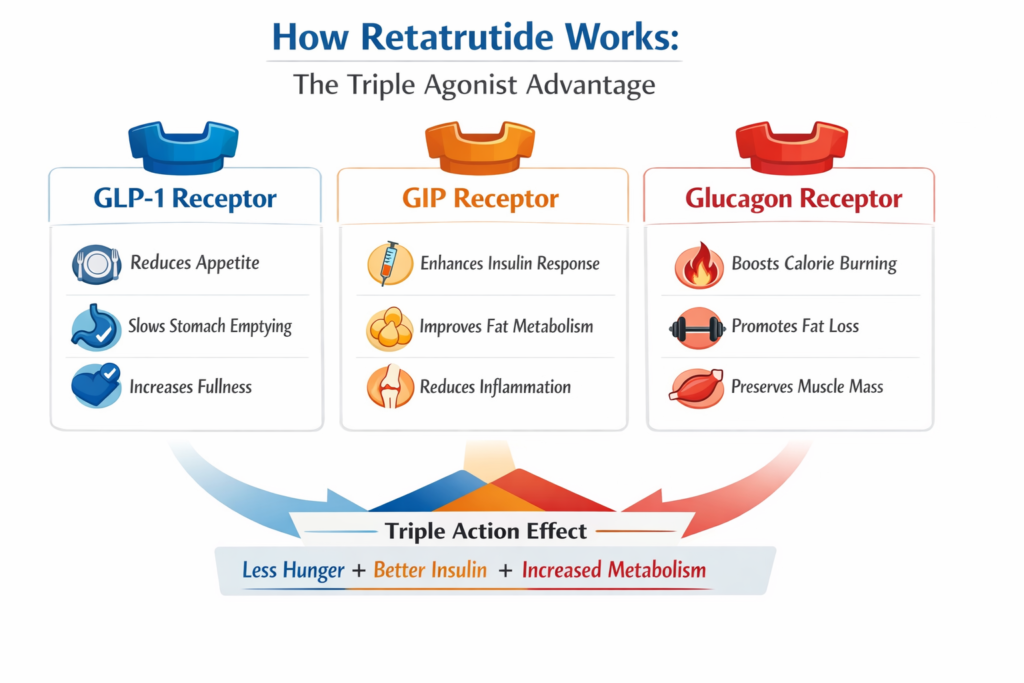
GLP-1 receptor agonism does what we already know from Ozempic: slows stomach emptying, reduces appetite, makes you feel full longer.
GIP receptor agonism adds what Zepbound brought: enhances insulin response, reduces inflammation, may improve fat metabolism.
Glucagon receptor agonism is the new player: increases energy expenditure (your body burns more calories at rest), promotes fat burning, may help preserve muscle mass.
Think of it this way: GLP-1 turns down your hunger. GIP fine-tunes how your body handles food. Glucagon turns up your metabolism. All three working together create a stronger effect than any one or two alone.
Most people on Ozempic or Zepbound hit a plateau eventually. Retatrutide’s three-pronged approach makes it harder for your body to compensate and resist further weight loss.
Weight Loss Results: What the Clinical Trials Actually Show
Phase III TRIUMPH-4 Trial Results (December 2025)
At 68 weeks on 12mg dose:
- Average weight loss: 28.7% of body weight
- Average pounds lost: 71.8 pounds
For context:
- 200-pound person: lost about 57 pounds
- 250-pound person: lost about 72 pounds
- 300-pound person: lost about 86 pounds
How This Compares to Current Options
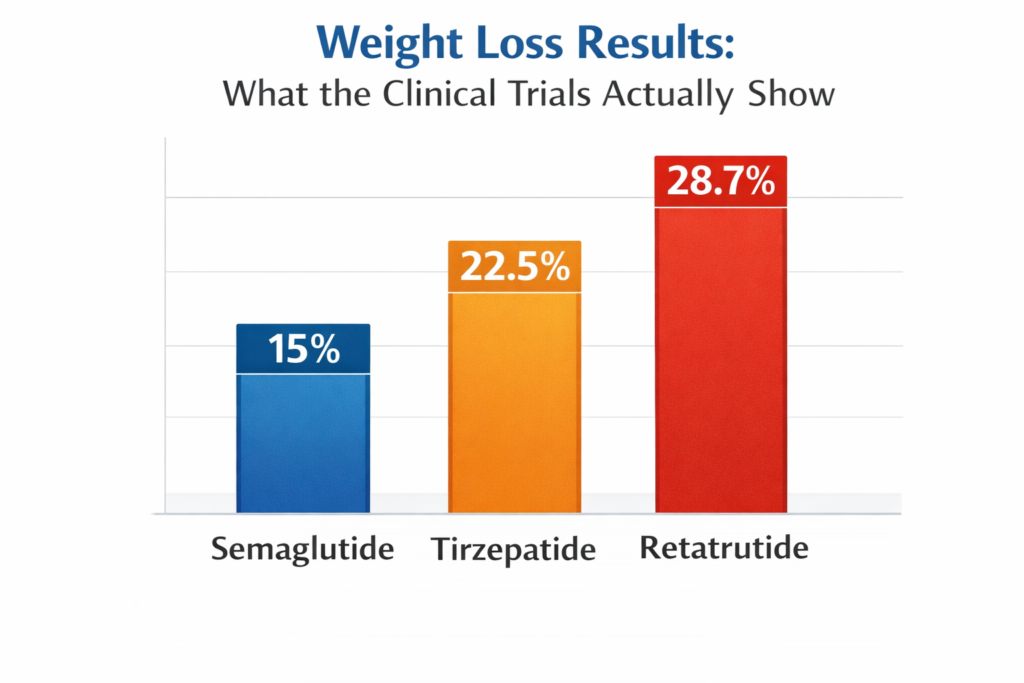
Semaglutide (Wegovy/Ozempic): Average 15% weight loss at one year (about 30-35 pounds for a 200-pound person)
Tirzepatide (Zepbound): Average 22.5% weight loss at 72 weeks (about 45 pounds for a 200-pound person)
Retatrutide: Average 28.7% weight loss at 68 weeks (about 57 pounds for a 200-pound person)
That’s roughly 27% more weight loss than Zepbound, and nearly double what Wegovy achieves.
Beyond the Scale
The TRIUMPH-4 trial also found 75% reduction in knee pain for people with osteoarthritis, plus improvements in physical function, cardiovascular risk markers, and blood pressure.
The Reality Check
Individual results vary. Some trial participants lost 35-40% of their body weight, others lost 15-20%. The 28.7% is an average. And like any GLP-1 drug, if you stop taking the medication, the weight typically returns.
Side Effects and Safety Concerns You Should Know About
The Expected Side Effects
Retatrutide causes the same digestive issues we see with every GLP-1 medication:
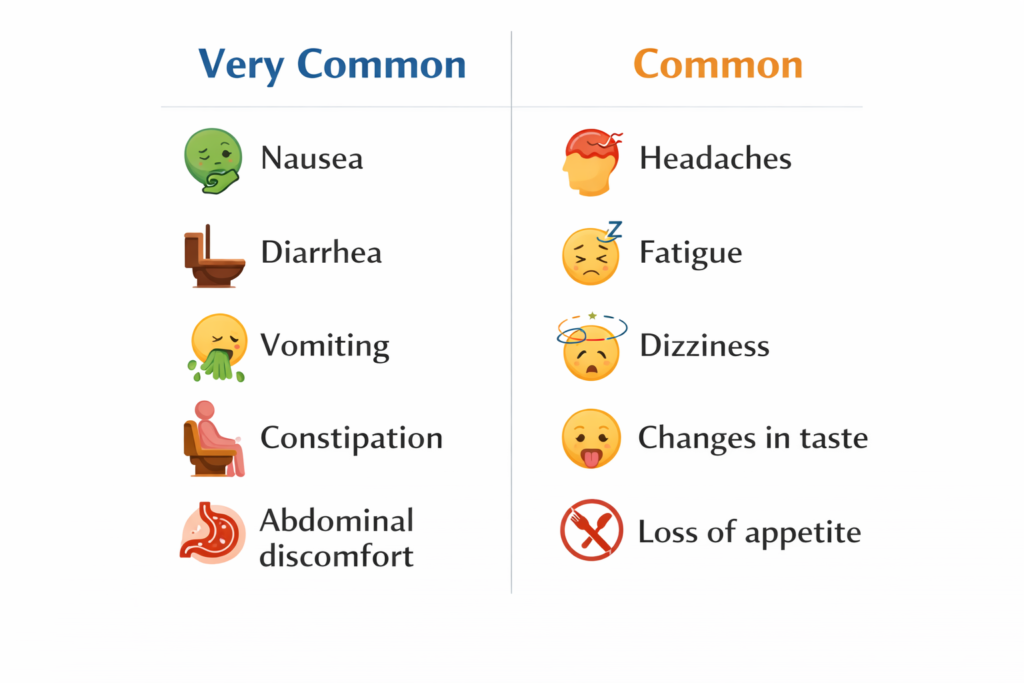
Most of these improve after the first few weeks, especially if you dose up slowly.
The New Safety Signal: Dysesthesia
Here’s the part that caught everyone’s attention in December 2025.
The TRIUMPH-4 trial revealed dysesthesia (abnormal sense of touch or skin sensations) that wasn’t seen in earlier Phase II trials.
What this looks like:
- Tingling or “pins and needles” feeling
- Numbness in hands or feet
- Unusual sensitivity to touch
- Burning sensations on the skin
Eli Lilly says these events “did not seem to lead to discontinuation,” which suggests they were mild. But it’s concerning because it wasn’t seen in earlier trials and it’s not something we see with Ozempic or Zepbound.
Analysts are watching for this in the seven remaining Phase III trials reading out in 2026.
Real User Experiences
The following are anonymized experiences shared by clinical trial participants in online forums (Reddit, r/Semaglutide, etc.).
“The nausea was rough the first month, but manageable with ginger and eating smaller amounts. By month two, it was mostly gone. The weight just kept coming off.”
“I’ve been on Reta for 108 days, dropped 28 pounds. Lately I’ve been feeling extremely lightheaded, almost to the point of fainting.”
“Like any GLP-1, the key is slow titration. Rush it and you’ll feel like garbage. Take your time moving up doses and it’s way more tolerable.”
Long-Term Safety: The Big Unknown
The longest trial data we have is 68 weeks. That’s not even a year and a half. For a medication people might take for decades, that’s a pretty short track record.
Questions still unanswered: Does the dysesthesia become permanent? What about thyroid concerns? Gallbladder issues? Muscle loss over multiple years?
Early adoption comes with unknowns. If you’re risk-averse, waiting for more long-term data makes sense.
If side effects are a big concern for you, SkinnyRx offers a microdosing program to help reduce side effects by slowly titrating up to a standard dose.
Retatrutide vs Tirzepatide (Zepbound): Which Is Better?
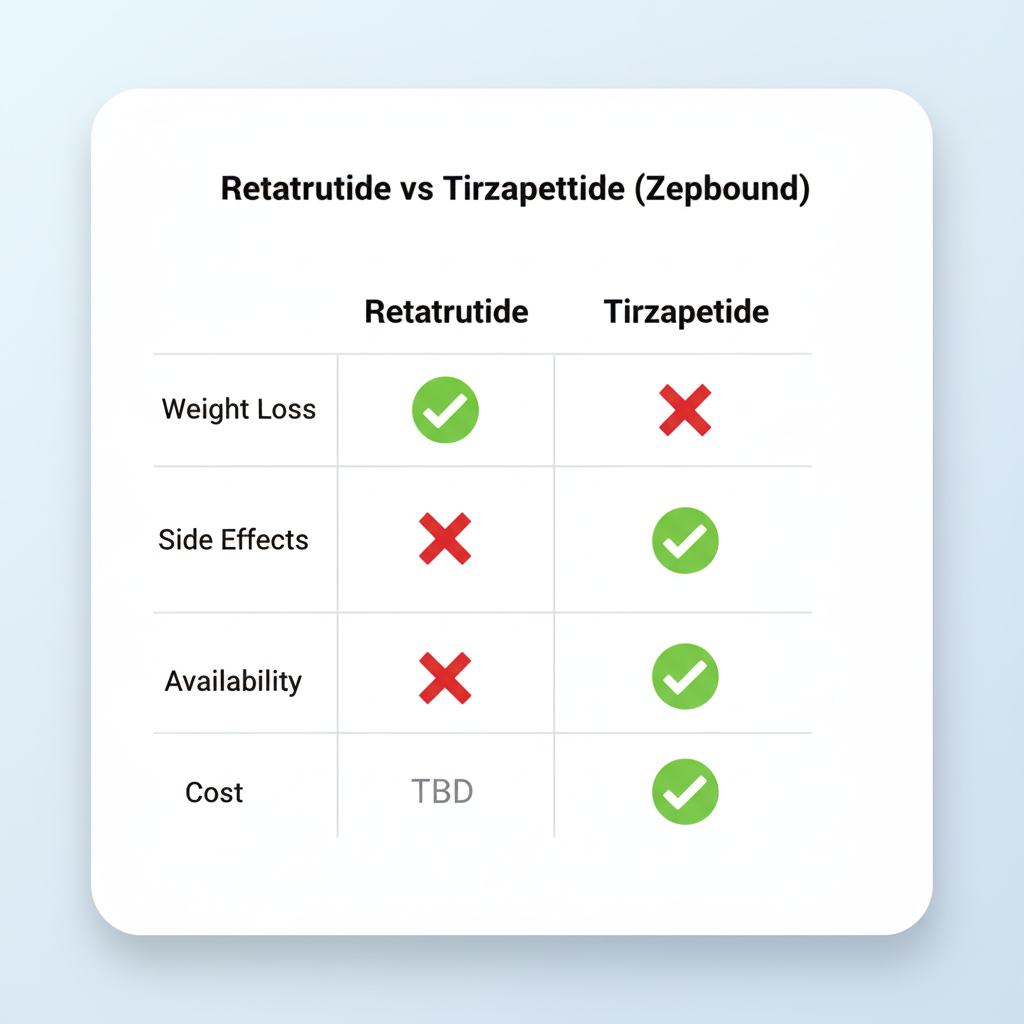
Weight Loss: Advantage Retatrutide
The numbers don’t lie. Tirzepatide: 22.5% weight loss. Retatrutide: 28.7% weight loss. If maximum weight loss is your only goal, retatrutide is ahead.
Side Effects: Possibly Advantage Tirzepatide
Both cause similar GI side effects. But retatrutide has that dysesthesia signal that tirzepatide doesn’t have. Tirzepatide has been on the market longer and we know what to expect.
A program that offers excellent physician support and a community group that can help you work through any side effects while on Tirzepatide is Yucca Health.
Availability: Big Advantage Tirzepatide
Tirzepatide is available right now through branded Zepbound/Mounjaro or compounded tirzepatide through telehealth. Retatrutide won’t be available until late 2027 at the earliest.
Cost: Unknown for Retatrutide
Branded retatrutide will likely be $1,200-1,500+ per month initially. Compounded tirzepatide typically costs $300-500/month right now.
My Take: Who Should Choose Which
Consider tirzepatide if:
- You need to start losing weight now
- You want a medication with more real-world safety data
- Cost is a major concern (compounded options available)
- You’re happy with 20-25% weight loss results
Consider waiting for retatrutide if:
- You’ve plateaued on tirzepatide and need more
- You’re seeking maximum possible weight loss (25-30%)
- You’re comfortable being an early adopter
- You can afford premium pricing or have great insurance
Honestly? For most people, starting with tirzepatide now makes more sense than waiting. If it doesn’t get you all the way to your goal, retatrutide will be available by the time you need it.
When Will Retatrutide Be Available and What Will It Cost?
The Official Timeline
2026: Seven more Phase III trial results, regulatory submission preparation (likely Q4 2026)
2027: FDA submission (early 2027), FDA review process (6-12 months), potential approval late 2027
2028: Commercial launch possible depending on manufacturing ramp-up
How to Access It Now: Clinical Trials
Eli Lilly is running multiple Phase III trials right now (TRIUMPH-1, TRIUMPH-2, TRIUMPH-3, and four more). You can search ClinicalTrials.gov for “retatrutide” to find trials, but most are already full or in late stages.
What to Do While You Wait
Option 1: Try tirzepatide (Zepbound). It’s the closest thing to retatrutide available now.
Option 2: Start with semaglutide. Cheaper than branded tirzepatide, still very effective.
Option 3: Use a compounded GLP-1 through telehealth. This is what most people in 2026 are doing and it is by far the cheapest option to provide you with the same results.
Medvi has over 12,000 reviews on Trustpilot and is a great well known telehealth provider that offers semaglutide and tirzepatide.
Expected Cost
Based on how Eli Lilly priced Zepbound ($1,060/month), expect retatrutide to cost $1,200-1,500/month initially with premium pricing because it’s new and more effective.
Insurance coverage will be limited initially. Expect prior authorization requirements and step therapy (try semaglutide, then tirzepatide, then maybe retatrutide).
Eli Lilly will likely launch savings programs similar to Zepbound (coupons reducing cost to $500-650/month for commercially insured patients).
Compounded retatrutide won’t be an option for years after FDA approval, if at all.
Who Should Consider Retatrutide?
Best Candidates
You might be a good fit if:
- You’ve hit a plateau on tirzepatide or semaglutide
- You have significant obesity (BMI 35+) with complications
- You have obesity-related joint problems (trial data showed major improvements in knee osteoarthritis pain)
- You respond poorly to current GLP-1s
- You have great insurance or can afford premium pricing
- You’re comfortable with limited long-term data
Who Should Stick With Current Options
Retatrutide might not be worth waiting for if:
- You’re losing weight well on current medications
- You’re risk-averse about new medications
- Cost is a major concern (compounded tirzepatide at $300/month is way more accessible)
- You need to start losing weight now
- You have mild to moderate obesity (current GLP-1s will likely get you to your goal)
My Personal Take
Start with what’s available now. Compounded semaglutide or tirzepatide through a telehealth program like DirectMeds that gets you losing weight immediately as they offer 1 day delivery!
Give it 6-12 months. See how much you lose and how you feel.
If you hit your goal weight, great! If you plateau before reaching your goal, then retatrutide becomes worth considering when it launches in 2027-2028.
This approach means you’re making progress now while keeping retatrutide as a backup option rather than waiting 18 months.
Next Steps
Ready to start your weight loss journey? Here are the most relevant resources:
- Tirzepatide vs Semaglutide: Which GLP-1 Medication Is Right for You?
- Injectable vs Oral GLP-1s: Comparing Effectiveness, Cost, and Convenience
- GLP-1 Medication Reviews: Real User Experiences and Results
Final Thoughts
Retatrutide represents genuinely exciting progress in obesity treatment. The 28.7% weight loss results are unprecedented.
But it’s not available yet, it’ll be expensive when it launches, and we still don’t know enough about long-term safety or that dysesthesia signal.
For most people reading this in February 2026, starting with compounded tirzepatide through telehealth is the smarter move. You’ll be losing weight within weeks, spending a fraction of what branded medications cost, and you can always switch to retatrutide in 2027-2028 if you need it.
The future of weight loss medication is bright. But the present has pretty good options too.
Ready to start losing weight now while you wait for retatrutide? Here are the programs we trust to get started with a compounded GLP-1 program today:
Medical Disclaimer:
This article is for informational purposes only and does not constitute medical advice. GLP-1 medications including retatrutide should only be used under the supervision of a licensed healthcare provider. Retatrutide is currently investigational and not approved by the FDA for any use. Individual results with weight loss medications vary significantly. Always consult with your doctor before starting or stopping any medication, and discuss your full medical history, current medications, and treatment goals. The information in this article is based on clinical trial data available as of February 2026 and is subject to change as new research emerges.
Sources:
Side effect information: Retatrutide adverse event reports from clinical trials, user experiences from clinical trial participants, safety signal analysis from pharmaceutical research
Various online chatboards and review sites such as reddit and trustpilot.
Affiliate Disclaimer:
This article contains affiliate links to telehealth weight loss programs. If you click through and make a purchase, we may earn a commission at no additional cost to you. We only recommend programs we’ve thoroughly researched and believe offer genuine value. Our reviews remain independent and unbiased regardless of affiliate relationships. You’re never obligated to use our links, and we encourage you to compare multiple providers before making any decision about your healthcare.
Last updated: June 2026