
Quick Answer:
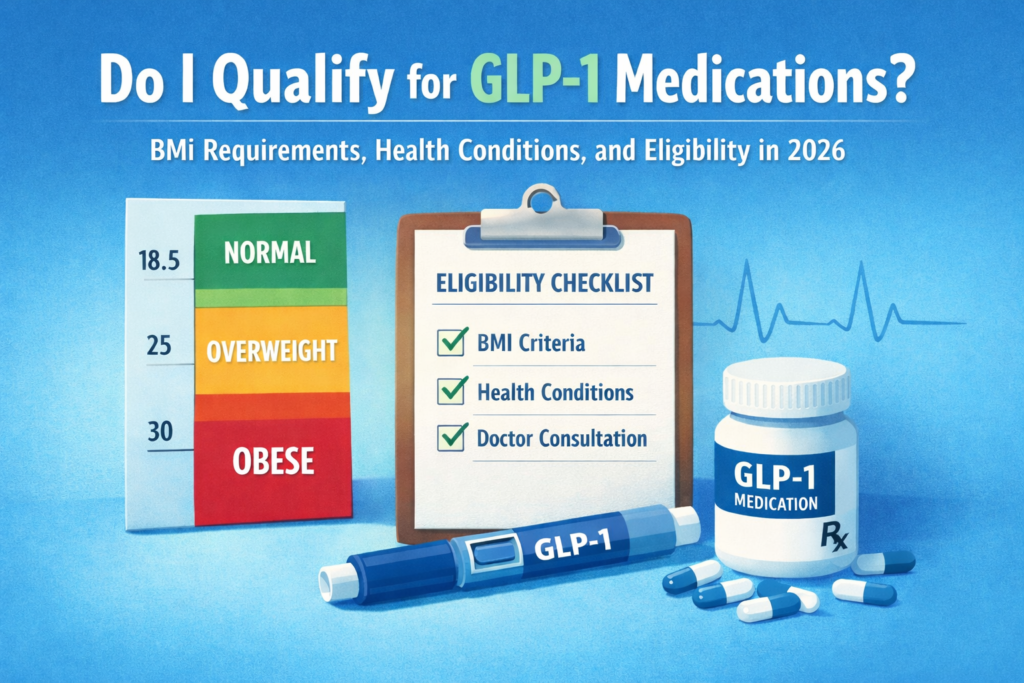
You qualify for GLP-1 medications if:
- You have a BMI of 30+ OR
- A BMI of 27-29.9 with at least one weight-related condition (like type 2 diabetes, high blood pressure, or sleep apnea)
- You must be 18+
- Don’t have a history of thyroid cancer or severe pancreatitis.
- Most telehealth providers can evaluate you and prescribe within 24-48 hours.
📋 Check Your Eligibility Now
• Use our free BMI calculator below
• Review qualifying conditions checklist
• Get evaluated online in 24-48 hours with one of our recommended providers
Over 2 million Americans started GLP-1 medications in 2025, but not everyone qualifies. If you’re wondering whether you qualify for GLP-1 medications like Wegovy, Ozempic, Mounjaro, or Zepbound, you’re asking the right question. Not everyone is a candidate for these medications, and understanding the requirements upfront saves you time and helps set realistic expectations.
The good news? The eligibility criteria are more straightforward than you might think. If you’ve been struggling with weight loss despite diet and exercise efforts, there’s a good chance you qualify.
In this guide, we’ll break down exactly who qualifies, what medical conditions are considered, and how the evaluation process works in 2026.
In This Guide:
- GLP-1 BMI Requirements: Do you Qualify?
- Weight-Related Health Conditions That Qualify You
- GLP‑1 Contraindications: Medical Conditions That Disqualify You.
- Age and Pregnancy Considerations
- How the Evaluation Process Works
- What If You’re Just Below the BMI Cutoff?
- Insurance vs. Cash-Pay Differences
- How GLP‑1 Online Evaluations Work in 2026
- Quick GLP-1 Qualification Checker
- What Happens If You Don’t Qualify?
- Key Takeaways
- Your Next Steps
- Final Thoughts
GLP-1 BMI Requirements: Do you Qualify?
The FDA has established clear Body Mass Index (BMI) criteria for GLP-1 weight loss medications. Here’s what you need to qualify:
According to the CDC, approximately 68% of U.S. adults have a BMI of 27 or higher, meaning the majority of Americans meet at least the minimum BMI threshold.
Option 1: BMI of 30 or Higher
If your BMI is 30 or above, you qualify for GLP-1 medications without needing any additional health conditions. This BMI threshold indicates obesity, which is itself a medical condition that warrants treatment.
Option 2: BMI of 27 or Higher + Weight-Related Health Condition
If your BMI is between 27-29.9, you can still qualify if you have at least one weight-related health condition (we’ll cover these in the next section).
Use our free BMI Calculator to do a quick check!
BMI Calculator
Check if you meet the basic BMI requirements
Understanding Your BMI
BMI is calculated using your height and weight:
BMI = weight (kg) / height (m)²
Or in pounds/inches:
BMI = (weight in pounds × 703) / (height in inches)²
Quick Reference Table:
| Height | Weight for BMI 27 | Weight for BMI 30 |
| 5’0″ | 140 lbs | 153 lbs |
| 5’2″ | 148 lbs | 164 lbs |
| 5’4″ | 157 lbs | 174 lbs |
| 5’6″ | 167 lbs | 186 lbs |
| 5’8″ | 177 lbs | 197 lbs |
| 5’10” | 188 lbs | 209 lbs |
| 6’0″ | 199 lbs | 221 lbs |
| 6’2″ | 210 lbs | 233 lbs |
Important note: BMI is not a perfect measure. It doesn’t account for muscle mass, body composition, or ethnic differences. However, it remains the standard criterion used by the FDA and most healthcare providers for medication eligibility.
Weight-Related Health Conditions That Qualify You
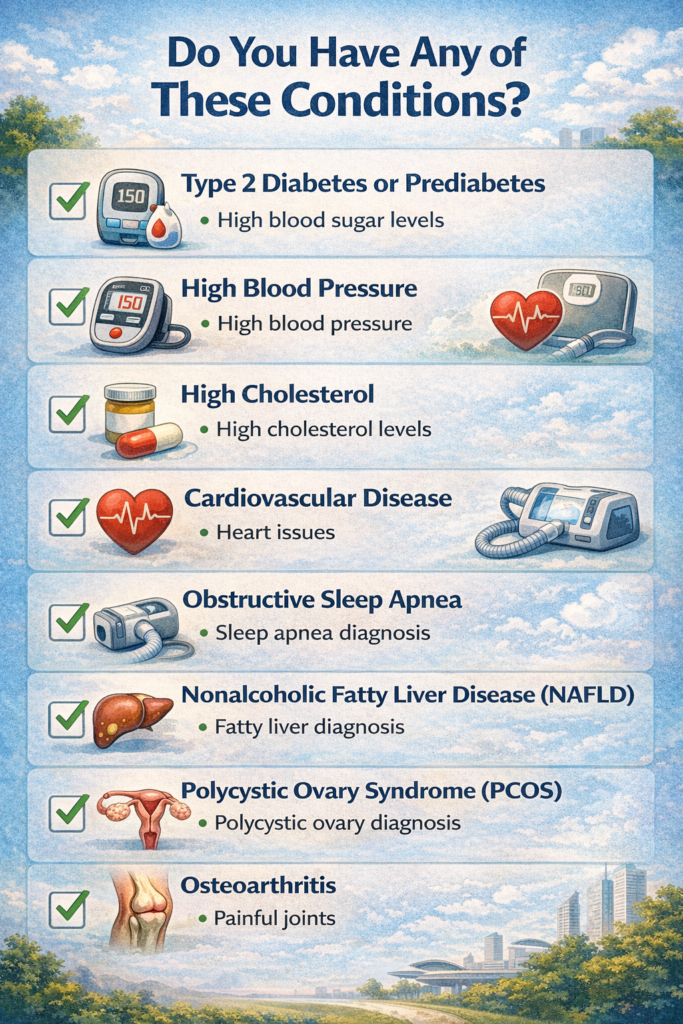
If your BMI is between 27-29.9, having any one of these conditions makes you eligible for GLP-1 medications:
✅ Type 2 Diabetes or Prediabetes
- Type 2 diabetes: Fasting glucose ≥126 mg/dL or A1C ≥6.5%
- Prediabetes: Fasting glucose 100-125 mg/dL or A1C 5.7-6.4%
- This is actually the original FDA-approved use for many GLP-1 medications
✅ High Blood Pressure (Hypertension)
- Blood pressure consistently ≥130/80 mmHg
- Currently taking blood pressure medication
- One of the most common qualifying conditions
✅ High Cholesterol (Dyslipidemia)
- LDL cholesterol ≥130 mg/dL
- Total cholesterol ≥200 mg/dL
- Triglycerides ≥150 mg/dL
- Low HDL cholesterol (<40 mg/dL for men, <50 mg/dL for women)
- Currently taking cholesterol medication
✅ Cardiovascular Disease
- History of heart attack or stroke
- Coronary artery disease
- Peripheral artery disease
- Heart failure
✅ Obstructive Sleep Apnea
- Diagnosed with a sleep study
- Using CPAP machine
- Documented by a healthcare provider
✅ Nonalcoholic Fatty Liver Disease (NAFLD)
- Diagnosed via ultrasound or imaging
- Elevated liver enzymes related to fatty liver
- Increasingly common condition
✅ Polycystic Ovary Syndrome (PCOS)
- Diagnosed by gynecologist or endocrinologist
- Often accompanied by insulin resistance
- Weight loss can significantly improve symptoms
✅ Osteoarthritis
- Joint pain worsened by excess weight
- Diagnosed by healthcare provider
- Weight loss can reduce joint stress and pain
Real-world example: Sarah is 5’6″ and weighs 175 pounds (BMI 28.2). She doesn’t qualify based on BMI alone, but she has high blood pressure (145/90) and prediabetes (A1C 6.1%). She qualifies for GLP-1 medications.
Medical Conditions That Disqualify You
While many people qualify, there are important contraindications and medical conditions that make GLP-1 medications unsafe for you.
Absolute Contraindications (You Cannot Take GLP-1s)
❌ Personal history of medullary thyroid carcinoma (MTC)
- A rare type of thyroid cancer
- Animal studies showed increased risk (not confirmed in humans)
- FDA requires this warning as a precaution
❌ Family history of medullary thyroid carcinoma
- First-degree relatives (parent, sibling, child) with MTC
- Indicates possible genetic predisposition
❌ Multiple Endocrine Neoplasia syndrome type 2 (MEN 2)
- Rare genetic condition
- Increases risk of certain tumors
❌ Currently pregnant or breastfeeding
- Not studied in pregnant/nursing women
- Potential risks to fetus or infant unknown
- Must stop 2 months before trying to conceive
❌ History of severe pancreatitis
- Especially if multiple episodes
- GLP-1s may increase pancreatitis risk
Relative Contraindications (Requires Careful Consideration)
⚠️ Severe gastroparesis (stomach paralysis)
- GLP-1s slow stomach emptying further
- Can worsen existing condition
- Discuss thoroughly with gastroenterologist
⚠️ History of eating disorders
- Anorexia, bulimia, or other disordered eating
- Extreme appetite suppression could worsen condition
- Requires psychiatric evaluation and close monitoring
⚠️ Severe kidney disease
- May require dose adjustment
- Dehydration risk higher
- Needs nephrologist approval
⚠️ Active gallbladder disease
- Rapid weight loss can worsen gallstones
- May need gallbladder removal first
⚠️ Diabetic retinopathy (advanced)
- Rapid blood sugar improvement can temporarily worsen eye issues
- Requires ophthalmologist monitoring
⚠️ Taking insulin or sulfonylureas
- Increased risk of low blood sugar
- Doses need careful adjustment
- Requires close medical supervision
Important: Having one of these relative contraindications doesn’t automatically disqualify you, but it means you need specialized medical supervision. Your healthcare provider will weigh the risks and benefits for your specific situation.
Age and Pregnancy Considerations
Age Requirements
Minimum age: 18 years old
- FDA approval is for adults 18 and older
- Some GLP-1s (like liraglutide) are approved for ages 12+ for obesity with type 2 diabetes
- Pediatric use for weight loss alone is limited
Maximum age: No upper limit
- Many people in their 60s, 70s, and even 80s successfully use GLP-1s
- Benefits often outweigh risks in older adults with obesity-related conditions
- May require closer monitoring for dehydration and medication interactions
Pregnancy and Breastfeeding
If you’re planning pregnancy:
- Stop GLP-1 medications at least 2 months before trying to conceive
- GLP-1s remain in your system for several weeks
- Not enough data on safety during pregnancy
If you become pregnant while taking GLP-1s:
- Stop medication immediately
- Contact your healthcare provider
- No evidence of harm, but insufficient data to confirm safety
If you’re breastfeeding:
- GLP-1 medications are not recommended
- Unknown if they pass into breast milk
- Wait until you’re done breastfeeding
Important note: Many women with PCOS find it easier to conceive after weight loss on GLP-1s. Plan your pregnancy timing carefully and discuss with your doctor.
How the Evaluation Process Works
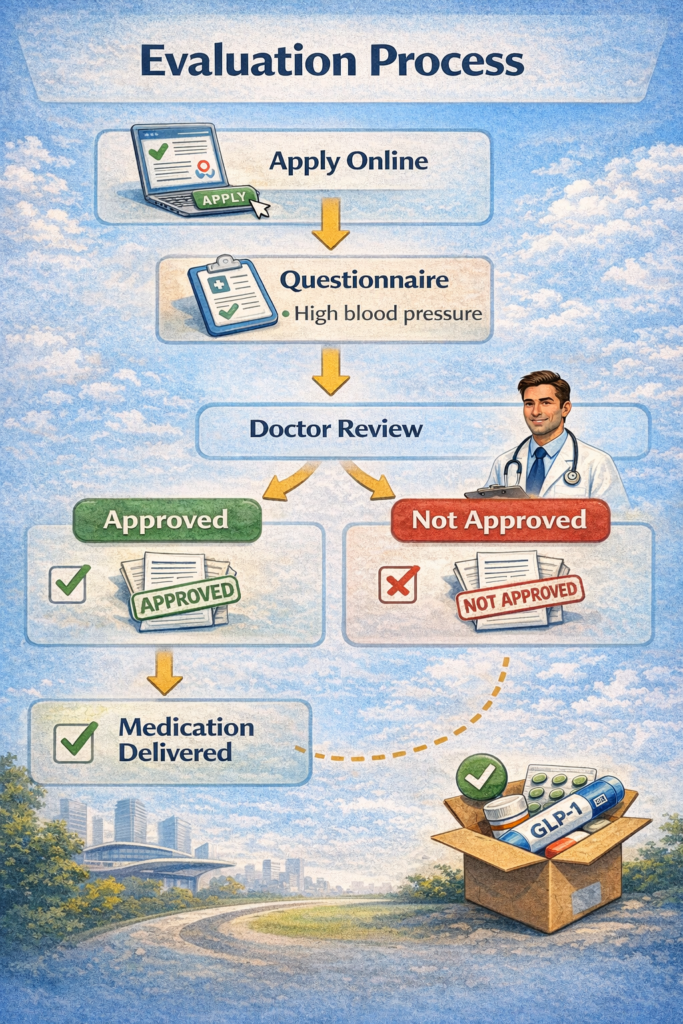
Whether you see a doctor in person or use a telehealth service, the evaluation process is similar:
Step 1: Initial Screening (5-10 minutes)
You’ll provide:
- Height and weight (to calculate BMI)
- Age and basic demographics
- Medical history (current conditions, past surgeries)
- Current medications
- Family medical history (especially thyroid cancer)
- Weight loss history (what you’ve tried before)
Step 2: Health Questionnaire (10-15 minutes)
More detailed questions about:
- Weight-related health conditions (diabetes, high blood pressure, etc.)
- Symptoms you experience related to weight
- Eating habits and lifestyle
- Mental health history
- Pregnancy plans
- Goals and expectations
Step 3: Medical Review (Same Day to 24 Hours)
A licensed healthcare provider reviews your information and determines:
- Whether you meet BMI and health criteria
- If you have any disqualifying conditions
- Which GLP-1 medication is best for you
- Starting dose and titration schedule
- Any additional lab work needed
Step 4: Prescription and Shipment (24-48 Hours)
If approved:
- Prescription is sent to pharmacy
- Medication shipped to your home
- Instructions provided for injection technique
- Follow-up schedule established
What If You’re Just Below the BMI Cutoff?
Let’s say your BMI is 26 or 28 without qualifying health conditions. You’re close, but not quite there. What are your options?
Option 1: Focus on Qualifying Health Screenings
Many people have qualifying conditions but don’t know it. Consider getting:
- Blood pressure check – many people have undiagnosed hypertension
- Lipid panel – check cholesterol and triglycerides
- Fasting glucose and A1C – screen for prediabetes
- Sleep study – if you snore or feel tired despite sleep
You might discover you qualify after all.
Option 2: Work with Your Healthcare Provider
Some providers have discretion in borderline cases, especially if:
- You have strong family history of obesity-related disease
- You’ve tried multiple weight loss methods without success
- You have documented weight-related symptoms (joint pain, mobility issues)
- Your weight is trending upward despite efforts
Option 3: Consider Lifestyle Changes First
If you’re just below the cutoff, you may benefit from:
- Working with a registered dietitian
- Structured exercise program
- Behavioral therapy for weight management
- Other weight loss medications (like phentermine, naltrexone/bupropion)
Option 4: Different Providers Have Different Criteria
Insurance-based providers: Strictly follow FDA BMI criteria
Telehealth/cash-pay providers: May have slightly more flexibility
- Some evaluate “overall metabolic health” beyond just BMI
- Consider body composition, not just weight
- May approve BMI 26+ in specific circumstances
Important: Legitimate providers won’t prescribe to people who clearly don’t qualify. Be wary of services that approve everyone without proper evaluation.
Insurance vs. Cash-Pay: Different Qualification Paths
The evaluation process can differ depending on how you’re paying:
Traditional Insurance Route
Stricter criteria:
- Must meet exact FDA BMI requirements
- Often requires documented “failed” diet attempts
- May need 3-6 months of supervised weight loss first
- Extensive prior authorization process
- More paperwork and waiting time
Benefits:
- Lower out-of-pocket cost if approved
- Covered by insurance
- Integrated with your primary care
Timeline: 4-12 weeks from initial request to approval
Telehealth/Cash-Pay Route
More streamlined:
- Same basic BMI/health requirements
- Faster evaluation (often same-day)
- Less documentation required
- No prior authorization needed
- Approval rate typically higher for borderline cases
Costs:
- You pay out of pocket ($200-$400/month)
- Some accept HSA/FSA
- No insurance claims or coverage
Timeline: 24-48 hours from application to medication delivery
| Factor | Insurance Route | Cash-Pay Telehealth |
| BMI Requirements | Strict (exactly 30, or 27 with condition) | Same, but slightly more flexible interpretation |
| Documentation Needed | Extensive (weight history, failed attempts) | Minimal (online questionnaire) |
| Approval Timeline | 4-12 weeks | 24-48 hours |
| Monthly Cost | $0-$50 copay (if covered) | $200-$400 out of pocket |
| Prior Authorization | Required | Not needed |
| Convenience | Multiple office visits | 100% online |
| Approval Rate | Lower (stricter criteria) | Higher (medical discretion) |
Which is right for you?
- Choose insurance if: Cost is your main concern and you clearly meet criteria
- Choose cash-pay if: You want fast access and don’t want insurance hassles
How GLP‑1 Online Evaluations Work in 2026
Telehealth has revolutionized access to GLP-1 medications. Here’s what the process looks like with reputable online providers:
What You’ll Need
Basic information:
- Current height and weight
- Government-issued ID (to verify age)
- Valid email and phone number
- Payment method (HSA/FSA often accepted)
Medical information:
- List of current medications
- Known health conditions
- Any allergies
- Recent blood work (if available, but often not required)
The Online Process (Step-by-Step)
1. Complete online questionnaire (10-15 minutes)
- Medical history questions
- Weight loss goals
- Lifestyle and eating habits
- Any disqualifying conditions
2. Photo or video consultation (varies by provider)
- Some require brief video call with provider
- Others do asynchronous review (no live call needed)
- Provider asks clarifying questions if needed
3. Medical review (same day or next day)
- Licensed physician or nurse practitioner reviews your case
- Determines eligibility and appropriate medication
- Sends prescription if approved
4. Medication delivery (2-7 days)
- Shipped directly to your door
- Includes injection supplies (needles, alcohol swabs)
- Instructions and support materials
- Most providers offer free shipping
5. Ongoing support
- Monthly check-ins (usually via messaging)
- Dose adjustments as needed
- 24/7 access to medical team
- Automatic refills
Red Flags: Illegitimate Online Providers
Be cautious of services that:
❌ Approve everyone without medical review
❌ Don’t require any health information
❌ Offer “discount” medications from overseas
❌ Don’t use licensed US physicians
❌ Promise results “without lifestyle changes”
❌ Charge excessive fees upfront
Legitimate providers will:
✅ Require detailed medical questionnaire
✅ Have licensed US healthcare providers review applications
✅ Deny applicants who don’t qualify
✅ Use FDA-approved or properly compounded medications
✅ Provide ongoing medical support
✅ Be transparent about costs
Special Situations: Do You Qualify?
BMI calculations don’t account for everyone’s situation. Here are common scenarios:
High Muscle Mass (Athletes/Bodybuilders):
BMI may overestimate body fat if you have significant muscle mass. Providers can use body composition analysis (DEXA scan or bioelectrical impedance) instead of relying solely on BMI.
Already Lost Weight But Plateaued:
Yes, you can still qualify if your current BMI meets criteria (30+, or 27+ with conditions). Many people use GLP-1s to break through plateaus or maintain weight loss.
Post-Bariatric Surgery Weight Regain:
With doctor approval, many bariatric patients successfully use GLP-1 medications to address weight regain years after surgery.
Hypothyroidism or PCOS:
These conditions often make weight loss difficult. If your BMI meets criteria, having these conditions may actually strengthen your case for approval.
Athletes or Muscular Builds
Question: “My BMI is 31, but I’m very muscular. Do I really qualify?”
Answer: BMI doesn’t account for muscle mass. If you have high muscle mass and low body fat, you may not actually need GLP-1 medications. However:
- If you also have excess body fat despite muscle mass, you might still benefit
- Your doctor should evaluate body composition, not just BMI
- Request a body composition analysis (DEXA scan, bioelectrical impedance)
Already Lost Weight But Plateaued
Question: “I lost 40 pounds on my own but can’t lose the last 30. Do I qualify?”
Answer: Yes! If your current BMI still meets the criteria (30+, or 27+ with health conditions), you can qualify even if you’ve already lost significant weight. Many people use GLP-1s to:
- Break through plateaus
- Lose the “last 20-30 pounds”
- Maintain previous weight loss
Post-Bariatric Surgery Weight Regain
Question: “I had gastric bypass 5 years ago but regained weight. Can I use GLP-1s?”
Answer: Usually yes, with doctor approval. Many bariatric patients successfully use GLP-1 medications for:
- Managing weight regain
- Getting back on track
- Supporting long-term maintenance
- Requires coordination with your bariatric surgeon
Hypothyroidism or PCOS
Question: “I have hypothyroidism/PCOS. Does that help me qualify?”
Answer:
- PCOS is a qualifying condition (especially with insulin resistance)
- Hypothyroidism alone doesn’t qualify you, but:
- If it’s caused weight gain above BMI thresholds, you qualify
- Often comes with other qualifying conditions (high cholesterol, etc.)
- Must be well-controlled on thyroid medication first
Bottom Line on Special Situations: If your situation is unique, the best approach is to complete an online evaluation. Licensed providers can assess your individual case and make appropriate recommendations.
Do You Need Lab Work Before Starting?
This varies by provider and your medical history:
Recommended Lab Work (Not Always Required)
Basic metabolic panel:
- Blood sugar (fasting glucose or A1C)
- Kidney function (creatinine, eGFR)
- Electrolytes
Lipid panel:
- Total cholesterol
- LDL, HDL, triglycerides
Liver function:
- ALT, AST (liver enzymes)
Thyroid function (if symptoms present):
- TSH, Free T4
When Labs Are Required
You’ll likely need recent labs if you:
- Have diabetes (need baseline A1C)
- Take other medications that affect kidneys or liver
- Have history of kidney disease
- Are over 60 years old
- Have other chronic health conditions
When Labs Are Optional
Many telehealth providers don’t require labs if:
- You’re generally healthy
- Under 50 years old
- No chronic conditions
- Recent physical exam was normal
Note: Even if not required upfront, your provider may request labs after 3-6 months to monitor your progress and ensure medication safety.
Quick Qualification Checker
Use this quick self-assessment to estimate your likelihood of qualifying:
✅ Check all that apply to you:
☐ I’m 18 years or older
☐ My BMI is 30 or higher
☐ OR my BMI is 27-29 AND I have at least one of these:
- Type 2 diabetes or prediabetes
- High blood pressure
- High cholesterol
- Sleep apnea
- Fatty liver disease
- PCOS
- Joint pain from excess weight
☐ I’m NOT pregnant or planning pregnancy in next 6 months
☐ I do NOT have personal/family history of thyroid cancer
☐ I have NOT had severe pancreatitis
☐ I do NOT have an active eating disorder
☐ I’ve tried diet and exercise without lasting success
Results:
- 6+ boxes checked: Very likely to qualify
- 4-5 boxes checked: Likely to qualify with provider review
- 2-3 boxes checked: May qualify depending on specifics
- 0-1 boxes checked: Unlikely to qualify at this time
What Happens If You Don’t Qualify?
Not qualifying doesn’t mean you’re out of options. Here are alternative paths:
Other FDA-Approved Weight Loss Medications
Phentermine:
- Appetite suppressant
- Lower BMI requirement (25+)
- Short-term use (3 months)
- Less expensive
Contrave (naltrexone/bupropion):
- Works on brain’s reward system
- BMI 30+, or 27+ with condition
- Taken as pills daily
Qsymia (phentermine/topiramate):
- Combination medication
- Similar BMI requirements to GLP-1s
- Pill form
Xenical/Alli (orlistat):
- Blocks fat absorption
- Available over-the-counter (lower dose)
- Different mechanism than GLP-1s
Lifestyle-Based Programs
Medical weight loss programs:
- Supervised by physicians
- Structured diet and exercise plans
- Behavioral counseling
- May include medications
Registered dietitian:
- Personalized nutrition plans
- Accountability and support
- Often covered by insurance
Bariatric surgery evaluation:
- For BMI 40+, or 35+ with serious conditions
- More invasive but highly effective
- Permanent solution for many
Reapply Later
If you’re close to qualifying:
- Work on lifestyle changes for 3-6 months
- Get health screenings to check for qualifying conditions
- Document your weight loss efforts
- Reapply when you meet criteria
Key Takeaways
✅ Most people qualify with BMI 30+, or 27+ with a weight-related health condition like diabetes, high blood pressure, or high cholesterol
✅ Telehealth makes evaluation faster and easier – often approved within 24-48 hours
✅ Certain conditions disqualify you – mainly thyroid cancer history, pregnancy, or severe pancreatitis
✅ Age requirement is 18+ with no upper age limit for appropriate candidates
✅ Lab work is helpful but not always required – depends on your health history
✅ If you don’t qualify, alternatives exist – other medications, lifestyle programs, or reapplication later
✅ The evaluation process is straightforward – honest answers about your health help ensure safe, appropriate treatment
Your Next Steps
If You Think You Qualify:
Step 1: Calculate your BMI using the table in this article
Step 2: Review your health conditions – do you have any qualifying conditions?
Step 3: Complete an online evaluation with a reputable provider
Step 4: Get your questions answered by reading related articles:
- GLP-1 Medication Reviews: Real User Experiences and Results
- Best Online GLP-1 Programs in 2026: Skinny Rx, Eden, Medvi, and Elevate Compared Side by Side
If You’re Unsure:
Step 1: Schedule a free consultation with a telehealth provider. They can review your specific situation
Step 2: Get recent health screenings (blood pressure, cholesterol, blood sugar). You might have qualifying conditions you don’t know about
Step 3: Learn more about what to expect:
- How GLP-1 Medications Work: Mechanisms, Timeline, and What to Expect [2026]
- GLP-1 Side Effects: What’s Normal, What’s Manageable, and When to Worry [2026]
- What Should I Eat While Taking GLP-1 Medications? Complete Diet Plan
- What Do I Need to Know About GLP‑1 Weight Loss? 15 Most Asked Questions Answered
Final Thoughts
The qualification criteria for GLP-1 medications are designed to ensure these powerful medications go to people who truly need them and can use them safely. If you meet the BMI requirements and don’t have disqualifying conditions, there’s a very good chance you’ll be approved.
The process has become remarkably simple in 2026, especially with telehealth options. Most people can complete an evaluation in 15 minutes and receive a decision within 24 hours.
The most important thing? Be honest in your medical questionnaire. These medications are safe and effective for the right candidates, but your healthcare provider needs accurate information to determine if they’re appropriate for you.
Don’t let uncertainty hold you back! If you think you might qualify, complete an evaluation and find out. The first step is always the hardest, but it could be the beginning of a life-changing journey.
Ready to find out if you qualify? Most online evaluations take less than 15 minutes and you’ll receive a decision within 24 hours. Start your evaluation today with one of our recommended providers.
Medical Disclaimer: This article is for informational purposes only and does not constitute medical advice. Eligibility criteria are based on FDA guidelines and may vary by provider. Only a licensed healthcare provider can determine if GLP-1 medications are appropriate for your specific situation. Always provide complete and accurate medical information during evaluations to ensure safe treatment.
Sources: FDA prescribing information for semaglutide and tirzepatide, clinical practice guidelines from the American Association of Clinical Endocrinologists (AACE), Obesity Medicine Association guidelines, and manufacturer eligibility criteria (2024-2026).
Affiliate disclosure: Some of our articles contain affiliate links. If you click on a link and purchase a GLP‑1 program or medication, we may earn a commission at no extra cost to you. This helps us keep researching and updating honest guides about GLP‑1 options.
Last Updated: February, 2026