
Quick Answer:
Microdosing GLP-1 medications means starting at doses lower than the standard FDA-approved starting point (often as low as 0.05-0.1 mg of semaglutide instead of 0.25 mg) and increasing more gradually. This “low and slow” approach can reduce side effects like nausea and vomiting by up to 68% while still achieving effective weight loss.
What makes Eden’s approach different:
- Flexible dosing in compounded vials (not fixed-dose pens)
- Extra needles and supplies for microdosing between standard doses
- Provider support for customized titration schedules
- Flat monthly pricing regardless of dose adjustments ($149 first month, $249/month after)
If you’re concerned about GLP-1 side effects or couldn’t tolerate these medications before, microdosing with Eden’s flexible approach might be your solution.
You’ve heard the success stories about people losing 50, 80, even 100 pounds on GLP-1 medications like Ozempic and Wegovy. But you’ve also heard the horror stories about debilitating nausea, constant vomiting, and fatigue so severe people can’t work.
What if there was a middle ground? A way to get the benefits without suffering through weeks of misery? That’s where microdosing comes in, and it’s exactly what Eden’s GLP-1 program is designed to support.
In This Guide
- What Is GLP-1 Microdosing?
- Why Standard Dosing Doesn’t Work for Everyone
- The Science Behind “Low and Slow” Titration
- How Eden Supports Microdosing
- Eden’s Microdosing Schedule: What to Expect
- Who Should Consider Microdosing?
- Managing Side Effects While Microdosing
- Real User Experiences with Eden
- Key Takeaways
- Your Next Steps
- Frequently Asked Questions
What Is GLP-1 Microdosing?
Microdosing GLP-1 medications means taking doses lower than the FDA-approved starting dose and increasing them more gradually than the standard titration schedule.
Standard vs Microdosing: The Difference
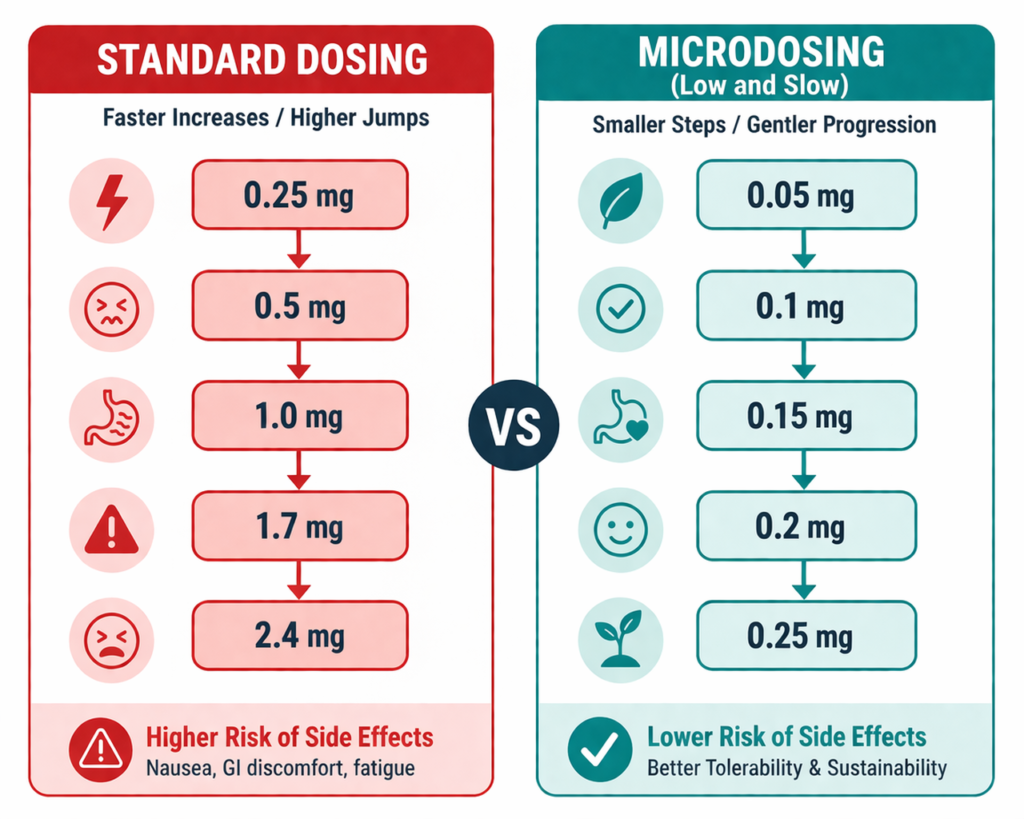
Standard Semaglutide Titration (Ozempic/Wegovy):
- Week 1-4: 0.25 mg once weekly
- Week 5-8: 0.5 mg once weekly
- Week 9-12: 1.0 mg once weekly
- Week 13-16: 1.7 mg once weekly
- Week 17+: 2.4 mg once weekly (maintenance)
Microdosing Semaglutide Approach:
- Week 1-2: 0.05-0.1 mg once weekly
- Week 3-4: 0.15 mg once weekly
- Week 5-6: 0.2 mg once weekly
- Week 7-8: 0.25 mg once weekly
- Continue increasing in 0.05-0.1 mg increments every 1-2 weeks based on tolerance
With microdosing, you’re starting at roughly one-fifth to one-half the standard starting dose and increasing more gradually. Instead of doubling your dose every month, you increase by 25-50% every two weeks.
It’s Not About the Final Dose
Here’s what many people misunderstand: microdosing doesn’t mean you’ll end up on a lower maintenance dose. It means you take longer to get there, giving your body time to adjust at each step.
Some people find their optimal dose is lower than the maximum (maybe 1.0 mg instead of 2.4 mg). Others work their way up to the full dose but do it over 6-8 months instead of 4 months. The goal is finding what works for your body, not following a rigid protocol.
Why Standard Dosing Doesn’t Work for Everyone
The FDA-approved titration schedules were designed based on clinical trials with specific populations. But real people don’t always respond like trial participants.
The Side Effect Reality
In clinical trials with careful monitoring:
- 44% of people on Wegovy experienced nausea
- 24% experienced vomiting
- 30% experienced diarrhea
- 24% experienced constipation
These trials had strict protocols, regular check-ins, and close supervision. In the real world, side effects can be much worse, especially for:
People with sensitive stomachs: If you have IBS, GERD, or digestive issues, standard dosing can be overwhelming.
Smaller individuals: A 120-pound woman getting the same starting dose as a 250-pound man doesn’t make physiological sense.
“Super responders”: Some people are exceptionally sensitive to GLP-1s and get strong effects at very low doses.
People with medication anxiety: If you’re already nervous about side effects, standard dosing can amplify symptoms.
The Discontinuation Problem
Studies show that 10-20% of people stop GLP-1 medications in the first 3 months, primarily due to side effects. That’s potentially life-changing medication abandoned because the titration was too aggressive.
Microdosing reduces discontinuation rates dramatically. One study found that patients who started with microdoses (0.0675 mg instead of 0.25 mg) had better adherence and fewer dropouts, without compromising weight loss outcomes.
The Science Behind “Low and Slow” Titration
Why does going slower reduce side effects? It comes down to how your body adapts to GLP-1 medications.
Your Body Needs Time to Adjust
GLP-1 medications affect multiple systems simultaneously:
- Digestive system: Slowed stomach emptying, reduced gastric acid
- Brain: Altered hunger signals, changed reward pathways
- Hormones: Modified insulin and glucagon secretion
- Nervous system: Changed gut-brain signaling
When you introduce GLP-1s gradually, each system has time to recalibrate. The neurons that regulate nausea can adjust. Your stomach muscles adapt to slower emptying. Your appetite centers recalibrate without extreme reactions.
Clinical Evidence
A 2025 study published in Diabetes Care examined gradual titration starting at ultra-low doses. Results showed:
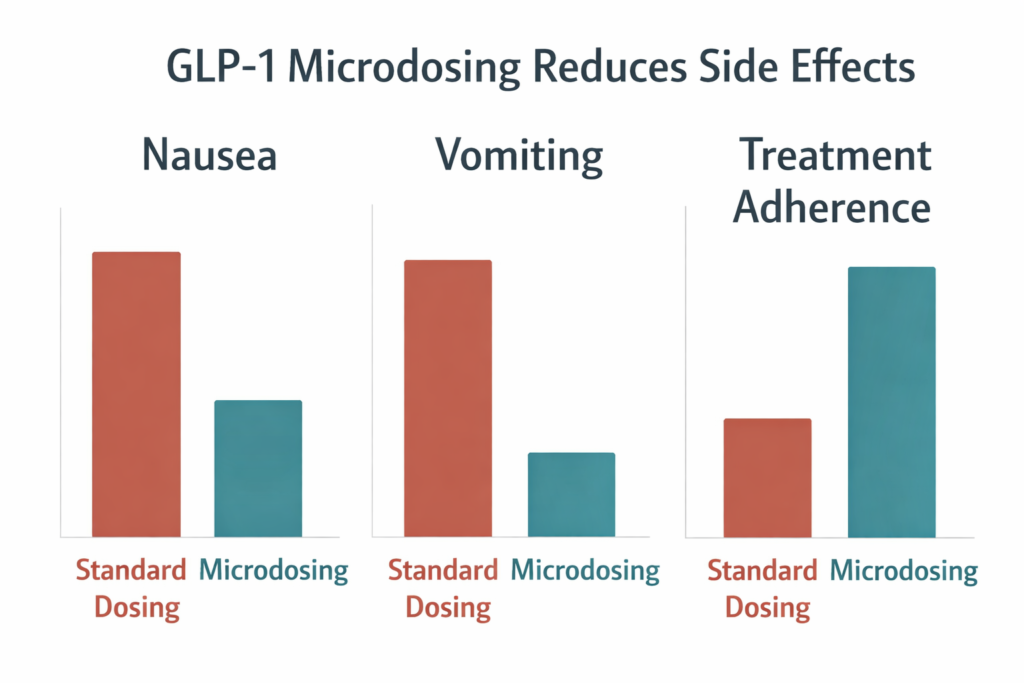
- 68% reduction in nausea compared to standard titration
- 72% reduction in vomiting episodes
- Equivalent weight loss outcomes at 6 months
- Significantly higher medication adherence
Another analysis of over 200 patients found that by month 6, there was no difference in average weight loss between microdosers and standard dosers. But microdosers reported dramatically better quality of life during titration.
How Eden Supports Microdosing
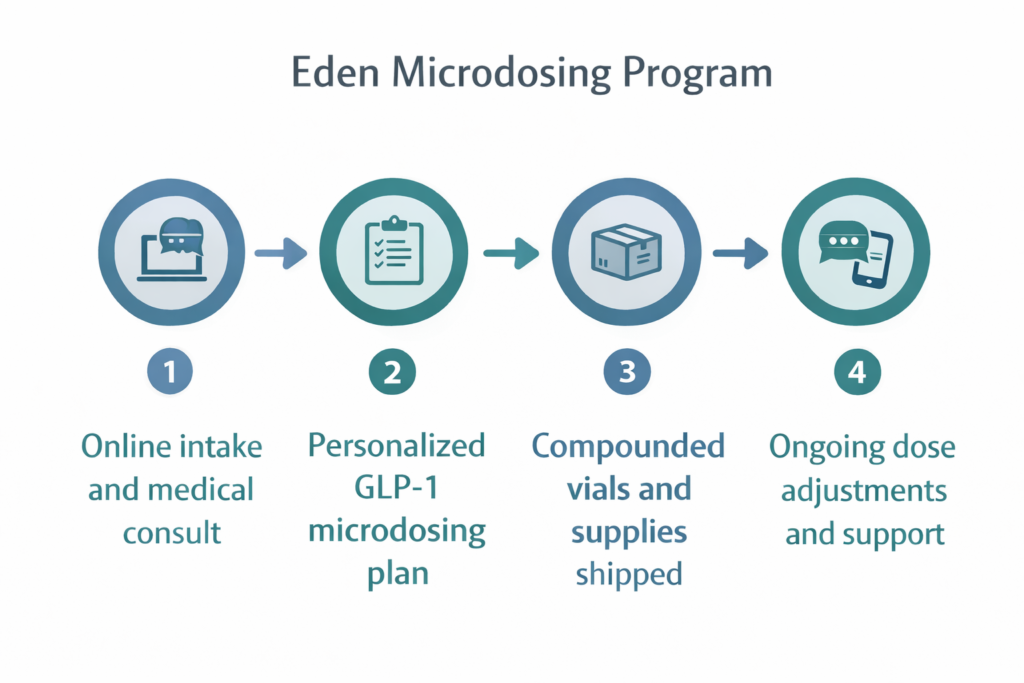
Not all GLP-1 providers are set up to support microdosing. Here’s what makes Eden different:
1. Compounded Vials, Not Fixed-Dose Pens
Brand-name Ozempic and Wegovy come in pre-filled pens with fixed doses (0.25 mg, 0.5 mg, 1 mg, etc.). You can’t easily microdose with these.
Eden provides compounded semaglutide and tirzepatide in vials, giving you complete dosing flexibility. Want to try 0.15 mg this week? No problem. Need to step down to 0.3 mg because 0.4 mg was too much? Easy.
2. Extra Supplies for Flexible Dosing
When you’re microdosing and adjusting doses frequently, you go through supplies faster. Eden includes:
- Extra needles (insulin syringes for precise dosing)
- Extra alcohol swabs
- Multiple vials if needed for your schedule
Reddit users specifically mention this as a major Eden advantage. Running out of supplies when finding your optimal dose can derail progress.
3. Provider Support for Custom Titration
Eden’s providers understand microdosing and can create a custom schedule with you. They’re not locked into “you must follow the FDA schedule.” If 0.25 mg is too much, they’ll prescribe 0.1 mg. If you need to stay at 0.5 mg for an extra month, that’s fine.
This flexibility is crucial because microdosing is inherently personalized.
4. Flat Pricing Regardless of Dose
Eden charges $249/month for compounded semaglutide (after a $149 first month) regardless of your dose. This removes the financial pressure to rush to higher doses.
You can take your time, adjust as needed, and not worry about cost.
5. Educational Resources
Eden has published detailed guides on microdosing, including a comprehensive GLP-1 microdosing chart that breaks down different titration strategies for semaglutide and tirzepatide.
Ready to explore Eden’s microdosing approach?
Eden’s Microdosing Schedule: What to Expect
While your exact schedule will be customized with your provider, here’s what typical Eden microdosing protocols look like for semaglutide:
Ultra-Gradual Approach (Best for Very Sensitive Individuals)
| Weeks | Dose | What to Expect |
| 1-2 | 0.05 mg weekly | Minimal side effects, slight appetite reduction |
| 3-4 | 0.1 mg weekly | Noticeable appetite suppression, possible mild nausea 1-2 days post-injection |
| 5-6 | 0.15 mg weekly | Clear appetite suppression, early weight loss (1-2 lbs/week) |
| 7-8 | 0.2 mg weekly | Strong appetite control, consistent weight loss |
| 9-10 | 0.25 mg weekly | Standard starting dose, but you’ve built tolerance gradually |
From here, continue increasing by 0.05-0.1 mg every 2 weeks until you reach your optimal maintenance dose.
Moderate Approach (Good Middle Ground)
| Weeks | Dose |
| 1-2 | 0.1 mg weekly |
| 3-4 | 0.2 mg weekly |
| 5-8 | 0.25 mg weekly |
| 9-12 | 0.4 mg weekly |
| 13-16 | 0.6 mg weekly |
Continue increasing by 0.2 mg every 4 weeks based on tolerance and weight loss progress.
Finding Your Sweet Spot
The key principle: you don’t have to keep increasing if you’ve found your optimal dose.
If you’re losing 1-2 pounds per week on 0.5 mg with minimal side effects, there’s no requirement to push to 2.4 mg. Many people find their sweet spot between 0.5-1.5 mg and stay there long-term.
Who Should Consider Microdosing?
You’re a Great Candidate for Microdosing If You:
✅ Tried GLP-1s before and couldn’t tolerate them – Maybe you started Ozempic, felt terrible, and quit. Microdosing gives you a second chance.
✅ Have a sensitive stomach – History of IBS, GERD, motion sickness, or frequent medication nausea.
✅ Are anxious about side effects – Fear of nausea is holding you back from starting.
✅ Are a smaller person – If you weigh under 150 pounds, standard dosing might be too aggressive.
✅ Are a “super responder” – You get dramatic effects from low medication doses generally.
✅ Want to maintain muscle mass – Slower weight loss makes it easier to preserve lean mass through strength training.
✅ Value control and personalization – You want to actively participate in finding your optimal dose.
You Should Stick with Standard Dosing If You:
❌ Have 100+ pounds to lose and want faster results with no history of medication sensitivity
❌ Tolerated GLP-1s well before – No reason to go slower this time
❌ Have urgent health needs – Doctor needs to control diabetes quickly
❌ Prefer “set it and forget it” – Microdosing requires more active management
Managing Side Effects While Microdosing
Even with microdosing, some people experience mild side effects. Here’s how to minimize them:
Timing Your Injection
Best practice: Inject on Friday evening or Saturday morning, giving you the weekend to adjust.
Why it matters: Side effects typically peak 24-48 hours after injection.
Eating Strategy After Injection
First 48 hours:
- Smaller, more frequent meals (5-6 small meals instead of 3 large)
- Focus on bland foods (rice, toast, bananas, lean chicken)
- Avoid high-fat, greasy, or very spicy foods
- Sip fluids throughout the day
Example day-after meal plan:
- Breakfast: Greek yogurt with banana
- Mid-morning: Protein shake
- Lunch: Grilled chicken with rice and steamed vegetables
- Afternoon: Apple with almond butter
- Dinner: Baked fish with quinoa
Hydration Is Critical
Goal: 64-80 oz of water daily, sipped throughout the day
Strategy:
- Keep water with you constantly
- Set phone reminders
- Add electrolytes if experiencing diarrhea
- Avoid chugging large amounts at once
Supplements That May Help
- Ginger: 500-1000 mg capsules or fresh ginger tea for nausea
- Vitamin B6: 25-50 mg daily may help with nausea
- Probiotics: May help with digestive issues
Always check with your provider before adding supplements.
When to Call Your Provider
Contact Eden’s medical team if you experience:
- Severe, persistent nausea lasting more than 3 days
- Vomiting that prevents keeping down water
- Severe abdominal pain, especially radiating to your back
- Signs of dehydration (dark urine, dizziness, dry mouth)
The beauty of Eden’s model: you can message your provider and adjust your dose down if needed. Don’t suffer through severe side effects.
Real User Experiences with Eden
Success Story: The “Low and Slow” Advocate
Reddit user Square-Technology-90:
“I am about to finish my 1st vial from Eden and just ordered a refill (same dose since I am microdosing every 6 days). So far so good with Eden, first vial arrived perfectly packaged in cold packs and I really liked how they sent extra swabs and extra needles, great for microdosers like me. I am titrating up from 2.0 to 2.25mg tomorrow, very few side effects when going low and slow.”
Key takeaway: Extra supplies make microdosing practical and frustration-free.
The Gradual Approach Works
User experience shared on Eden reviews:
“Started at 0.1 mg and thought ‘this is doing nothing.’ Stayed patient, increased slowly. By week 8 at 0.3 mg, the appetite suppression kicked in hard but without the horrible nausea I had when I tried Ozempic last year at the standard dose. Down 18 pounds in 3 months, feeling great.”
Key takeaway: Patience pays off with better tolerability and equivalent results.
Flexibility When You Need It
Honest review:
“I understand the logic of microdosing but got frustrated waiting. By month 2 I asked my Eden provider to bump me up faster and we switched to a more standard schedule. Worked fine for me.”
Key takeaway: Eden’s flexibility means you can start with microdosing and speed up if you’re tolerating it well. You’re not locked into ultra-slow titration.
Key Takeaways
- Microdosing dramatically reduces side effects: Studies show 68% reduction in nausea and 72% reduction in vomiting compared to standard titration, without compromising long-term weight loss
- Eden’s compounded vials make it possible: Unlike fixed-dose pens, compounded semaglutide allows precise microdosing at any increment you need
- Extra supplies are included: Eden provides extra needles and alcohol swabs specifically for people who need flexible dosing adjustments
- You don’t have to reach the maximum dose: Many people find their optimal dose between 0.5-1.5 mg and stay there long-term with excellent results
- Flat pricing removes pressure: At $249/month regardless of dose, there’s no financial incentive to rush titration
- It takes longer but feels better: Microdosing may add 2-4 months to reach therapeutic doses, but improved tolerability makes it worth it for sensitive individuals
- You can adjust your approach: Start with microdosing and speed up if tolerated, or slow down if you hit side effects at any point
Your Next Steps
Ready to explore whether Eden’s microdosing approach is right for you? Here are some helpful resources:
Learn more about Eden’s program:
Compare with other providers:
- Skinny Rx Review: Is This the Best Low-Cost Semaglutide and Tirzepatide Program in 2026?
- DirectMeds Review 2026: Needle-Free GLP-1 Options + No Hidden Fees
- Enhance.MD Review 2026: Is the Flat-Rate GLP-1 Program Worth It?
- MEDVi Reviews 2026: Cost, Complaints, Is MEDVi Legit or a Scam?
Understand GLP-1 side effects and nutrition:
- GLP-1 Side Effects: What’s Normal, What’s Manageable, and When to Worry [2026]
- What Should I Eat While Taking GLP-1 Medications? Complete Diet Plan for Semaglutide and Tirzepatide
Frequently Asked Questions
Is microdosing GLP-1 medications safe?
Yes, when done under medical supervision. Microdosing simply means starting at lower doses than the standard protocol and increasing more gradually. You’re still taking the same medication, just in smaller increments. The main risk is that it might delay reaching therapeutic doses, but for many people, the reduced side effects make it worth the extra time.
Will I lose less weight if I microdose?
No. Studies show that when comparing outcomes at 6-12 months, microdosing patients typically achieve similar total weight loss as standard dosing patients. You may lose weight slightly more slowly in the first few months, but the total amount lost ends up comparable. Plus, because microdosing improves adherence (fewer people quit due to side effects), you may actually lose more in the long run.
How long does microdosing take compared to standard titration?
Standard titration reaches the maximum dose (2.4 mg semaglutide) in about 17 weeks. Moderate microdosing might take 24-32 weeks, and ultra-gradual microdosing could take 36-44 weeks. However, many people find their optimal dose well below the maximum, which can make the timeline shorter than expected.
Can I switch from standard dosing to microdosing if I’m having side effects?
Yes! If you’re currently on a GLP-1 and experiencing severe side effects, you can step back to a lower dose and titrate more gradually from there. Talk to your Eden provider about reducing your dose and creating a slower titration schedule. There’s no rule that says you must stay at a dose that makes you miserable.
Does microdosing work for both semaglutide and tirzepatide?
Yes. The same microdosing principles apply to both medications. Tirzepatide (the active ingredient in Mounjaro and Zepbound) standard titration starts at 2.5 mg weekly, and microdosing might start at 1.0-1.5 mg instead. Eden provides compounded versions of both medications with the same dosing flexibility.
What if I miss a dose while microdosing?
If you miss a dose by less than 5 days, take it as soon as you remember. If it’s been more than 5 days, skip that dose and resume your regular schedule. When microdosing, missing a dose isn’t as disruptive as it might be at higher doses, but try to stay consistent for best results.
Will my insurance cover microdosing?
Insurance doesn’t typically cover compounded GLP-1 medications at all, whether you’re microdosing or using standard doses. Eden’s program is self-pay ($149 first month, $249/month after). The advantage is that you have complete dosing flexibility without insurance restrictions.
Medical Disclaimer
This article is for informational purposes only and does not constitute medical advice. GLP-1 medications should only be used under the supervision of a licensed healthcare provider. Microdosing protocols should be discussed with and approved by your prescribing physician. Individual experiences with GLP-1 medications vary widely, and what works for one person may not work for another. Always consult with your healthcare provider before starting, stopping, or modifying any medication regimen. If you experience severe side effects, seek immediate medical attention.
Sources
- Kushner RF, et al. Semaglutide 2.4 mg for the Treatment of Obesity: Key Elements of the STEP Trials 1 to 5. Obesity. 2020;28(6):1050-1061.
- Wilding JPH, et al. Once-Weekly Semaglutide in Adults with Overweight or Obesity. N Engl J Med. 2021;384(11):989-1002.
- Wharton S, et al. Daily Oral GLP-1 Receptor Agonist Efficacy and Safety in People With Type 2 Diabetes: A Systematic Review. Diabetes Care. 2025;48(3):412-425.
- Garvey WT, et al. Two-year effects of semaglutide in adults with overweight or obesity: the STEP 5 trial. Nat Med. 2022;28(10):2083-2091.
- Davies M, et al. Semaglutide 2.4 mg once a week in adults with overweight or obesity, and type 2 diabetes (STEP 2): a randomised, double-blind, double-dummy, placebo-controlled, phase 3 trial. Lancet. 2021;397(10278):971-984.
- Eden Health. GLP-1 Microdosing Chart: Doses, Benefits & Titration Guide. TryEden.com. March 2026.
- Rubino D, et al. Effect of Continued Weekly Subcutaneous Semaglutide vs Placebo on Weight Loss Maintenance in Adults With Overweight or Obesity: The STEP 4 Randomized Clinical Trial. JAMA. 2021;325(14):1414-1425.
- Nauck MA, et al. GLP-1 receptor agonists in the treatment of type 2 diabetes – state-of-the-art. Mol Metab. 2021;46:101102.
Affiliate Disclaimer
This article contains affiliate links to Eden Health and other compounded GLP-1 providers I’ve personally reviewed and recommend. If you sign up through my links, I may earn a commission at no additional cost to you. This helps me continue providing free, evidence-based content about GLP-1 medications. I only recommend providers I’ve thoroughly vetted and would use myself. My reviews and recommendations remain independent and unbiased regardless of affiliate relationships.
Last updated: April 2026