
Quick Answer:
As of April 2026, GLP-1 medication coverage for weight loss is complicated and varies wildly by insurance type:
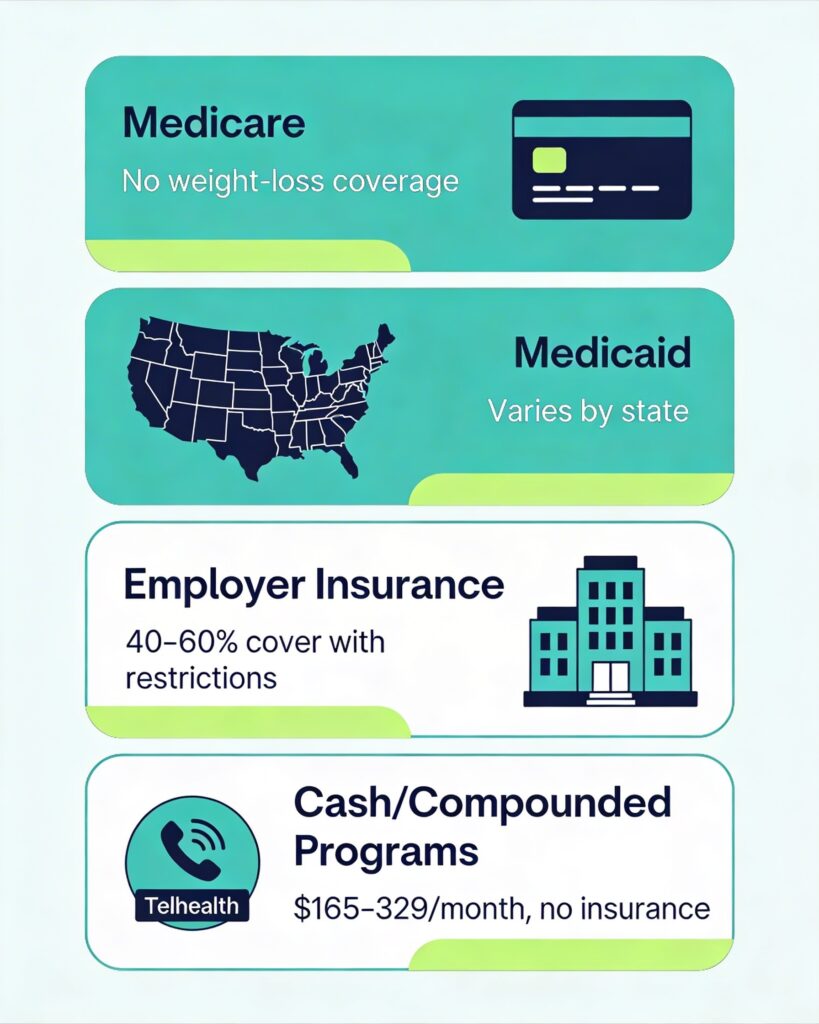
- Medicare: Still does not cover GLP-1s for weight loss only, despite ongoing political pressure to change this
- Medicaid: Coverage varies by state. Some cover it, most don’t
- Commercial insurance: About 40-60% of employer plans offer some coverage, but with heavy restrictions
- Prior authorization: Required by nearly all plans that do cover it, with frequent denials
Average out-of-pocket cost: $900-1,400/month for brand-name medications without coverage and between $165-$329/month for compounded options.
If you want to skip the insurance battle entirely, DirectMeds offers compounded semaglutide and tirzepatide with no insurance required.
In This Guide
- Does Medicare cover GLP-1 medications for weight loss?
- What about Medicaid coverage by state?
- Commercial insurance: Who covers it and who doesn’t?
- How to navigate prior authorization requirements
- What to do if you’re denied coverage
- Affordable alternatives when insurance won’t cover it
- How Insurance Coverage Might Change in the Future
- Key Takeaways
Does Medicare Cover GLP-1 for Weight Loss?
The Frustrating Reality
As of April 2026, Medicare does NOT cover GLP-1 medications prescribed solely for weight loss. This includes Wegovy, Ozempic (when prescribed off-label for weight loss), Zepbound, and Mounjaro (off-label).
This is due to a specific prohibition in the Medicare Modernization Act of 2003 that prevents Medicare from covering medications used for weight loss or weight gain.
However, there’s a major loophole:
Medicare DOES cover these same medications when prescribed for type 2 diabetes. So:
- Ozempic for diabetes: Covered ✓
- Ozempic for weight loss: Not covered ✗
- Mounjaro for diabetes: Covered ✓
- Mounjaro for weight loss: Not covered ✗
What This Means for You
If you have Medicare and type 2 diabetes, you can get Ozempic or Mounjaro covered. The weight loss is a “side effect” that your doctor doesn’t need to mention in the paperwork.
If you have Medicare and obesity but NOT diabetes, you’re out of luck with Medicare coverage. Your options are:
- Pay out of pocket for brand-name ($900-1,400/month)
- Use compounded versions through telehealth ($165-329/month)
- Wait for potential legislative changes (don’t hold your breath)
Political Push for Change
There’s been ongoing political pressure to allow Medicare to cover GLP-1s for obesity. Some legislators argue that covering these medications would save money long-term by preventing diabetes, heart disease, and other obesity-related conditions.
But as of April 2026, nothing has changed. Don’t count on Medicare coverage anytime soon.
Medicaid Coverage: It Depends on Your State
Medicaid coverage for GLP-1 weight loss medications varies dramatically by state.
States That Generally Cover GLP-1s for Weight Loss
These states have Medicaid programs that typically cover at least some GLP-1 medications for obesity (with restrictions):
- California
- New York
- Massachusetts
- Connecticut
- Minnesota
- Oregon
- Washington
- Vermont
Important: Even in these states, coverage comes with requirements like:
- BMI thresholds (usually 30+ or 27+ with comorbidities)
- Prior authorization
- Step therapy (trying older weight loss drugs first)
- Lifestyle intervention requirements
- Time limits on coverage
States With Limited or No Coverage
Most states fall into this category. They either:
- Don’t cover GLP-1s for weight loss at all
- Only cover in extremely limited circumstances
- Have such restrictive criteria that almost no one qualifies
Check Your State’s Coverage
Your best bet is to:
- Call your state’s Medicaid office directly
- Ask specifically about “coverage for GLP-1 receptor agonists for obesity”
- Get the requirements in writing
- Have your doctor help you navigate prior authorization
If your state doesn’t cover it, compounded versions through telehealth are your most affordable option.
Medvi offers compounded GLP-1 medications with support navigating insurance questions.
Commercial Insurance: The Wild West of Coverage
If you have insurance through your employer or the marketplace, coverage is all over the map.
The Current Landscape (2026)
Estimated coverage rates:
- 40-60% of employer-sponsored plans offer SOME coverage for GLP-1 weight loss medications
- Of those that cover it, most have heavy restrictions
- Large employers (500+ employees) are more likely to cover it than small businesses
- Tech companies and progressive employers tend to have better coverage
Common Coverage Scenarios
Scenario 1: Full Coverage (Rare)
Your plan covers Wegovy or Zepbound with manageable copays ($25-$100/month). You still need prior authorization, but approval is straightforward if you meet BMI requirements.
Estimated prevalence: 5-10% of plans
Scenario 2: High-Tier Coverage (More Common)
Your plan covers it, but it’s on the highest specialty tier with:
- $300-$600/month copays
- Prior authorization required
- Step therapy (must fail other treatments first)
- Annual or lifetime caps on coverage
Estimated prevalence: 20-30% of plans
Scenario 3: Diabetes Only (Very Common)
Your plan covers Ozempic and Mounjaro for diabetes but explicitly excludes coverage for weight loss indications.
Estimated prevalence: 30-40% of plans
Scenario 4: Complete Exclusion (Also Very Common)
Your plan has a blanket exclusion for all weight loss medications, including GLP-1s.
Estimated prevalence: 30-40% of plans
How to Check Your Coverage
Step 1: Find your insurance plan’s formulary (list of covered drugs)
- Usually available on your insurance company’s website
- Look under “pharmacy benefits” or “prescription drug list”
Step 2: Search for these drug names:
- Wegovy (semaglutide for weight loss)
- Zepbound (tirzepatide for weight loss)
- Saxenda (older GLP-1 for weight loss)
Step 3: Check the tier and restrictions
- Tier 1-2: Lower copay (good)
- Tier 3-4: Higher copay (expect $200-$600/month)
- Specialty tier: Highest cost, often percentage-based
- Look for “PA” (prior authorization required)
- Look for “ST” (step therapy required)
Step 4: Call your insurance company directly
Ask: “Does my plan cover GLP-1 medications like Wegovy or Zepbound when prescribed for obesity without diabetes?”
Get the answer in writing via email or mail.
Prior Authorization: The Insurance Hurdle
If your insurance does cover GLP-1s for weight loss, you’ll almost certainly need prior authorization (PA). This is where insurance decides if they’ll actually pay for it.
What Prior Authorization Requires
Most insurance companies require documentation of:
1. BMI Requirements:
- BMI 30 or higher (obesity), OR
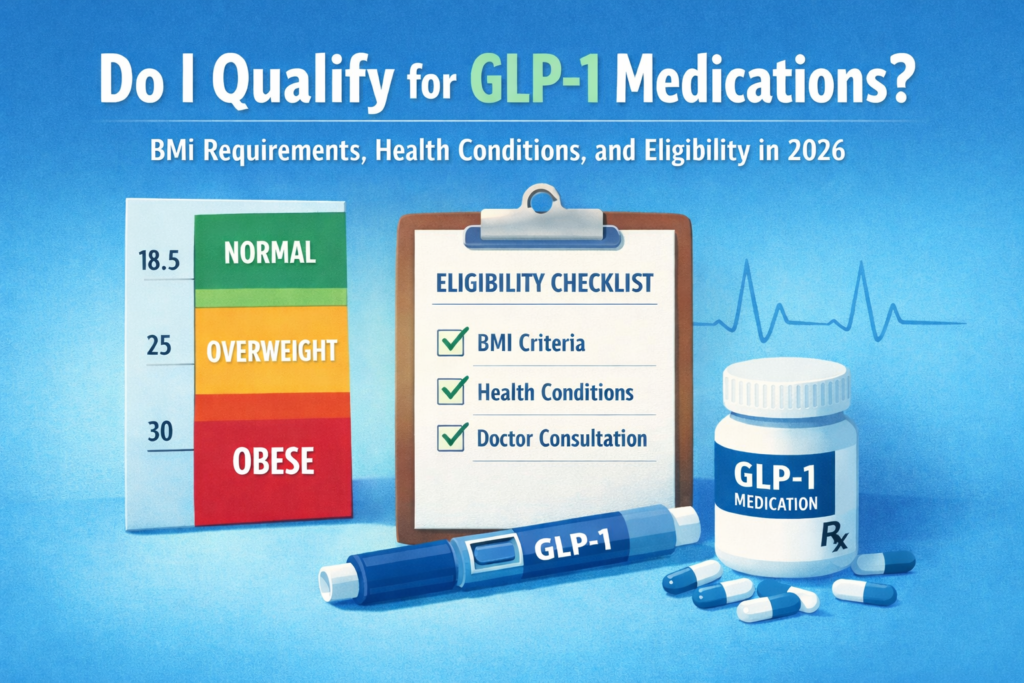
- BMI 27 or higher with at least one weight-related comorbidity (high blood pressure, high cholesterol, sleep apnea, type 2 diabetes, etc.)
2. Medical Necessity:
- Documented weight-related health problems
- History of failed weight loss attempts
- Evidence that other methods haven’t worked
3. Step Therapy (Often Required):
- Must have tried and failed older weight loss medications first (phentermine, orlistat, etc.)
- Some plans require 3-6 months of documented lifestyle interventions
- Must show inadequate weight loss with previous treatments
4. Lifestyle Intervention:
- Participation in a structured diet program
- Regular exercise regimen
- Behavioral counseling or support groups
5. No Contraindications:
- No history of medullary thyroid cancer or MEN 2 syndrome
- No personal or family history of certain conditions
The Prior Authorization Timeline
- Your doctor submits PA: Day 1
- Insurance review period: 3-15 business days
- Common outcome: Initial denial
- Appeal process: Another 15-30 days
- Total time to approval (if you get it): 1-3 months
Many people give up during this process and switch to compounded versions.
What to Do If You’re Denied Coverage
Most initial prior authorization requests are denied. Here’s what to do:
Step 1: Understand Why You Were Denied
Common denial reasons:
- “Not medically necessary”
- “Doesn’t meet step therapy requirements”
- “BMI doesn’t meet threshold”
- “Lack of documentation”
- “Excluded from plan benefits”
Your denial letter will state the specific reason.
Step 2: File an Appeal
You have the right to appeal. Your doctor will need to:
- Write a letter of medical necessity explaining why you specifically need this medication
- Provide documentation of failed prior treatments
- Include any relevant research or clinical guidelines
- Emphasize health risks of your current weight
Most plans allow multiple levels of appeal:
- Level 1: Internal review by insurance company
- Level 2: External review by independent third party
- Level 3: State insurance commissioner complaint (varies by state)
Step 3: Try Alternative Approaches
Ask about off-label coverage:
If you have pre-diabetes or metabolic syndrome, your doctor might be able to prescribe Ozempic or Mounjaro “for blood sugar management.” Insurance might cover it even though weight loss is your primary goal.
Check for manufacturer assistance:
- Novo Nordisk has savings programs for Wegovy/Ozempic
- Eli Lilly has savings programs for Zepbound/Mounjaro
- These typically only work if you have commercial insurance (not Medicare/Medicaid)
- Can reduce cost to $500-$650/month
Consider changing plans during open enrollment:
If you know your current plan won’t cover it, check other options during your employer’s open enrollment period. Some plans are more GLP-1 friendly.
Step 4: Calculate If It’s Worth the Fight
Be realistic about your chances:
- If your plan has a blanket exclusion for weight loss meds, appeals rarely work
- If the issue is documentation, appeals often succeed
- If it’s step therapy, you might need to actually try (and fail) older medications first
Fighting insurance for 3-6 months while paying $1,200/month out of pocket isn’t sustainable for most people.
Eden offers both compounded and brand-name options, so you can switch based on your insurance situation. Check it out here.
Affordable Alternatives When Insurance Won’t Cover It
If insurance won’t cover GLP-1 medications, you have better options than paying $900-1,400/month for brand-name drugs.
Option 1: Compounded GLP-1 Medications
This is what most people do in 2026.
What it is: U.S. compounding pharmacies make semaglutide and tirzepatide that’s chemically identical to Wegovy/Ozempic and Zepbound/Mounjaro.
Cost: $165-329/month depending on the program and medication
How it works: Online telehealth programs connect you with doctors who prescribe compounded versions. No insurance needed.
Best programs:
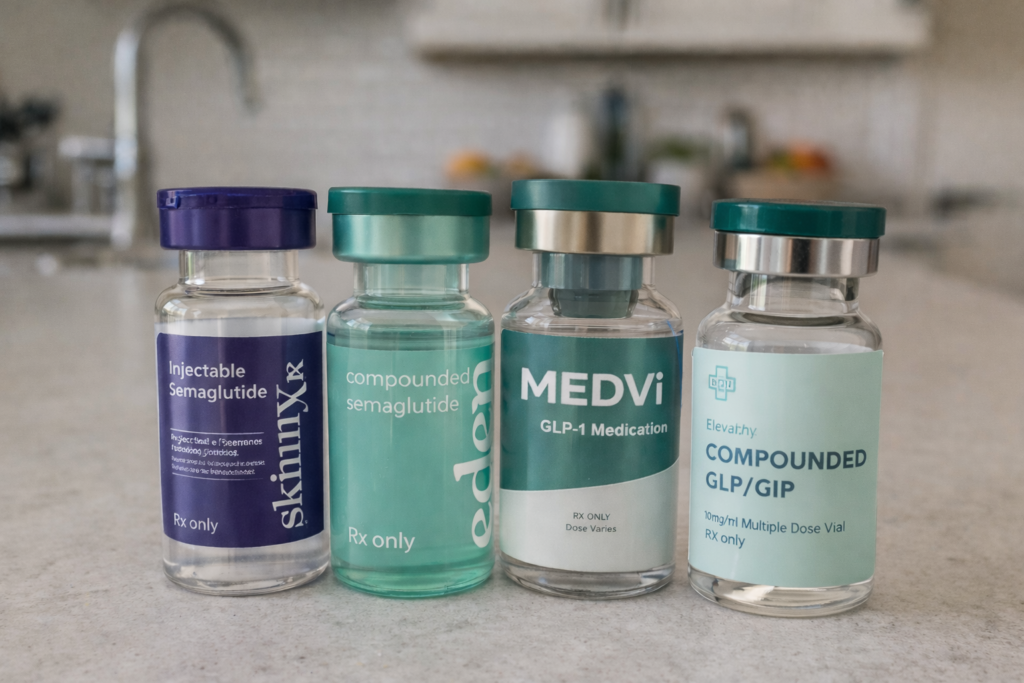
- Elevate: $165/mo semaglutide, $229/mo tirzepatide (3-month commitment)
- Skinny Rx: $199/mo semaglutide, $299/mo tirzepatide (month-to-month)
- Eden: $229/mo semaglutide, $329/mo tirzepatide (includes coaching)
This is 75-85% cheaper than brand-name out-of-pocket costs.
Option 2: Manufacturer Savings Programs
If you have commercial insurance (not Medicare/Medicaid), drug manufacturers offer coupons:
Wegovy Savings Card (Novo Nordisk):
- Can reduce cost to as low as $500/month
- Only for commercially insured patients
- Annual income limits may apply
Zepbound Savings Card (Eli Lilly):
- Can reduce cost to $550-650/month
- Similar restrictions as Wegovy
Important: These don’t work if:
- You have Medicare or Medicaid
- You’re paying completely out of pocket
- Your insurance explicitly excludes weight loss medications
Option 3: Medical Tourism (Risky)
Some people travel to Mexico or Canada to buy brand-name GLP-1s at lower prices ($200-400/month).
I don’t recommend this because:
- Quality control concerns
- Legal gray areas bringing medications across borders
- No medical oversight or support
- Dosing and storage issues
Stick with legitimate U.S.-based options.
Option 4: Clinical Trials
Some pharmaceutical companies are running clinical trials for new weight loss medications. If you qualify, you might get free medication and medical monitoring.
Search ClinicalTrials.gov for:
- “Obesity”
- “Weight loss”
- “GLP-1”
- Your location
Pros: Free medication, close medical monitoring
Cons: May get placebo, strict requirements, frequent appointments
How Insurance Coverage Might Change in the Future
Here’s what could happen in the next few years:
Medicare Coverage Expansion (Possible by 2027-2028)
Legislation has been proposed to allow Medicare to cover GLP-1s for obesity. If it passes:
- Would cover drugs like Wegovy and Zepbound for weight loss
- Estimated to cost Medicare $13-35 billion annually
- Could reduce long-term healthcare costs by preventing diabetes and heart disease
Political will seems to be growing, but it’s not guaranteed.
More Employer Plans Adding Coverage (Likely)
As generic versions of older GLP-1s become available and prices drop, more employers may add coverage. Already seeing this trend in 2026 vs 2024.
State-Level Mandates (Some States)
A few states are considering legislation requiring insurance plans to cover obesity treatment, including GLP-1s. Watch for movement in:
- California
- New York
- Massachusetts
Continued Compounded Availability (Uncertain)
The FDA could change regulations around compounded GLP-1s. Current shortage status allows compounding, but if shortages resolve, this could change.
Don’t wait for these changes. If you need GLP-1 medication now, use what’s available now.
Key Takeaways
- Medicare does NOT cover GLP-1s for weight loss (only for diabetes)
- Medicaid coverage varies by state (most states don’t cover it)
- 40-60% of commercial insurance plans offer some coverage, but with heavy restrictions
- Prior authorization is required by nearly all plans and frequently denied
- Brand-name out-of-pocket costs: $900-1,400/month
- Compounded versions through telehealth: $165-329/month (no insurance needed)
- Manufacturer savings programs can reduce brand-name costs to $500-650/month for commercially insured patients
- Fighting insurance can take 3-6 months with no guarantee of success
- Most people in 2026 use compounded versions as the most practical solution
Your Next Steps
If you want to try getting insurance coverage:
- Check your plan’s formulary for Wegovy/Zepbound
- Call insurance to confirm coverage and requirements
- Work with your doctor on prior authorization
- Be prepared for denials and appeals
- Have a backup plan (compounded options)
If you want to skip the insurance fight, check out these telehelth provider reviews:
- Skinny Rx Review: Is This the Best Low-Cost Semaglutide and Tirzepatide Program in 2026?
- Eden GLP‑1 Program Review: Flat-Fee Pricing, Coaching Support, and Who It Works Best For
- MEDVi Reviews 2026: Cost, Complaints, Is MEDVi Legit or a Scam?
- DirectMeds Review 2026: Needle-Free GLP-1 Options + No Hidden Fees
- Enhance.MD Review 2026: Is the Flat-Rate GLP-1 Program Worth It?
Sources: Information compiled from clinical nutrition guidelines, FDA prescribing information for semaglutide and tirzepatide, Academy of Nutrition and Dietetics recommendations, peer-reviewed research on GLP-1 medications and body composition, and real-world patient experiences (2022-2026).
Affiliate disclosure: This article contains affiliate links. If you click on a link and end up purchasing a GLP-1 program or medication, we may earn a commission at no extra cost to you. This helps us keep researching and updating honest, in-depth guides about GLP-1 options.
Medical Disclaimer: This article is for informational and educational purposes only and does not constitute medical advice. The content provided on this website is not intended to diagnose, treat, cure, or prevent any disease or health condition.
GLP-1 medications, including semaglutide and tirzepatide, are prescription medications that require evaluation and approval by a licensed healthcare provider. These medications may not be suitable for everyone and can cause side effects. Common side effects include nausea, vomiting, diarrhea, constipation, and abdominal pain. More serious side effects may occur, including the potential risk of thyroid C-cell tumors.
Do not use GLP-1 medications if you or your family have a history of medullary thyroid carcinoma (MTC) or Multiple Endocrine Neoplasia syndrome type 2 (MEN 2).
Always consult with a qualified healthcare professional before starting any new medication or weight loss program. Your doctor should review your complete medical history, current medications, and health status to determine if GLP-1 therapy is appropriate for you.
Individual results may vary. Weight loss results mentioned in this article are not guaranteed and depend on many factors including diet, exercise, metabolism, adherence to treatment, and individual health conditions.
The compounded medications discussed in this article are not FDA-approved. Compounded medications are custom-made by compounding pharmacies and have not undergone FDA review for safety or effectiveness. They may differ from FDA-approved brand-name products in concentration, formulation, and other characteristics.
Sublingual (oral) GLP-1 formulations are compounded preparations and have not been studied as extensively as FDA-approved injectable versions. Efficacy and safety profiles may differ from traditional injectable GLP-1 medications.
If you experience severe side effects or adverse reactions while taking GLP-1 medications, seek immediate medical attention.
Learn more about your options:

Updated: April 2026